
On this page
A talk track is a plan for a sales conversation: what the call is for, how you open, which questions you ask, the two or three points you want the buyer to remember, how you answer the objections you expect, and the next step you ask for. It is not a script. A rep with a good talk track knows where the conversation should go and chooses the words on the call. Below: how it differs from a script, how to build one, a template to copy and three examples.
- A talk track fixes the goal, the questions and the next step. The wording stays with the rep.
- Build it backwards: decide what the buyer should agree to at the end, then plan how to get there.
- Keep it to one page. If a rep has to read it during the call, it is too long.
- A talk track works when the rep can run it out loud with a buyer who pushes back. Rehearse before the real call.
What a talk track means
In sales, a talk track is the outline of one type of conversation that a rep can follow without reading it. The meaning of talk track is closer to a route than to a text: it marks the stops and leaves the driving to the rep. A typical talk track has five parts:
- The goal. What the buyer should agree to by the end of the call: a meeting, a demo, a pilot, a call with the person who signs.
- The opening. Two or three sentences that say who you are, why you are calling and why now.
- The questions. What you need to learn about the buyer’s situation and problem before you talk about your product.
- The value points. Two or three things your product changes for this buyer, each with proof.
- Objections and the next step. Answers to the pushback you hear most often, and the exact ask that ends the call.
Teams usually write one talk track per conversation type: a cold call, a discovery call, a demo, a price objection.
Talk track or talk tract?
The term is “talk track,” as in a track to run on. “Talk tract” is a misspelling.
Talk track vs sales script
| Talk track | Sales script | |
|---|---|---|
| Wording | Key points and questions; the rep chooses the words | Full sentences, said as written |
| Flexibility | Follows the buyer and comes back to the plan | Works while the buyer stays on the expected path |
| When it fits | Discovery, demos, objections, complex B2B deals | Short, repeated calls with few branches; wording that compliance has approved |
| How reps learn it | Practice the conversation out loud with someone who pushes back | Memorize the text |
| Risk | Too vague: the rep improvises everything | Sounds read; breaks on the first unexpected question |
Many teams use both: a script for the sentences that must be exact, such as a required disclosure, and a talk track for the rest. A sales playbook is the wider document: buyers, deal stages, the talk tracks for each stage and the rules for discounts.
How to build a talk track, step by step
Write one conversation at a time. The six steps work for a cold call and for a late-stage negotiation alike.
Step 1: Decide what the call is for
Start from the end. Write down the one next step you want the buyer to agree to, as specifically as you would put it in the calendar: “a 30-minute demo with the operations director next week,” not “interest.” Everything else is there to get to that ask.
Step 2: Know the buyer and what they care about
Name the role, not the company: an operations director, a finance lead, a head of support. For that role, write what they are measured on, what usually goes wrong for them, and what they probably do not know yet.
Step 3: Write the opening
Two or three sentences: who you are, why you are calling this person, and a question that hands the conversation to them. It is the one part worth writing out in full.
“Hi, I’m calling from a company that offers an end-to-end platform for route optimization, dispatch and driver management, and I’d love to tell you a bit about it.”
“I work with delivery teams on missed time windows. Is that something you’re dealing with this quarter, or is it under control?”
Step 4: Plan your questions
List three to five questions in the order you would like to ask them. If you need a structure, SPIN Selling groups questions into four types: situation, problem, implication and need-payoff1. Situation questions establish facts, problem questions find what is not working, implication questions explore what it costs, and need-payoff questions let the buyer say what a fix would be worth. Look up the facts before the call so you need fewer situation questions.
Step 5: Pick two or three value points
For this buyer, what does your product change? Write each point as a result, not a feature, and add the proof you can give on the call: a customer story you are allowed to tell, a number from a pilot, a short demo.
Step 6: Prepare answers to the objections you expect
List the three objections reps hear most often in this conversation, and for each one write how to acknowledge it, one question that finds what is behind it, and the answer. Then write the ask from step 1 as the last line of the talk track, so the call ends there and not with “I’ll send you some information.”
A talk track template you can copy
Copy the block into a document, one per conversation type, and fill in the brackets.
Conversation: [cold call / discovery call / demo / objection / renewal]
Goal of the call: [the next step the buyer agrees to, with who and when]
Buyer: [role] · cares about [what they are measured on] · usually struggles with [problem] · probably doesn’t know [what you can show them]
Opening (2–3 sentences): [who you are] + [why you are calling them, now] + [a question that hands them the conversation]
Questions (3–5): 1. [situation] 2. [problem] 3. [implication: what the problem costs] 4. [need-payoff: what fixing it would mean]
Value points (2–3): [result for this buyer] — proof: [story, number or demo you can use]
Likely objections: [objection] → acknowledge: [words] → ask: [question] → answer: [point]
The ask: [the exact sentence that proposes the next step, with a date]
Avoid: [phrases, claims or discounts the rep should not use on this call]
Keep the last field: it is where the team writes down what lost deals before, such as the early discount or the feature list in the first minute.
Talk track examples
The template filled in for three conversations. The examples are illustrative: the rep, the buyers and the product are made up. In all three, Gideon sells route-planning software to delivery companies.
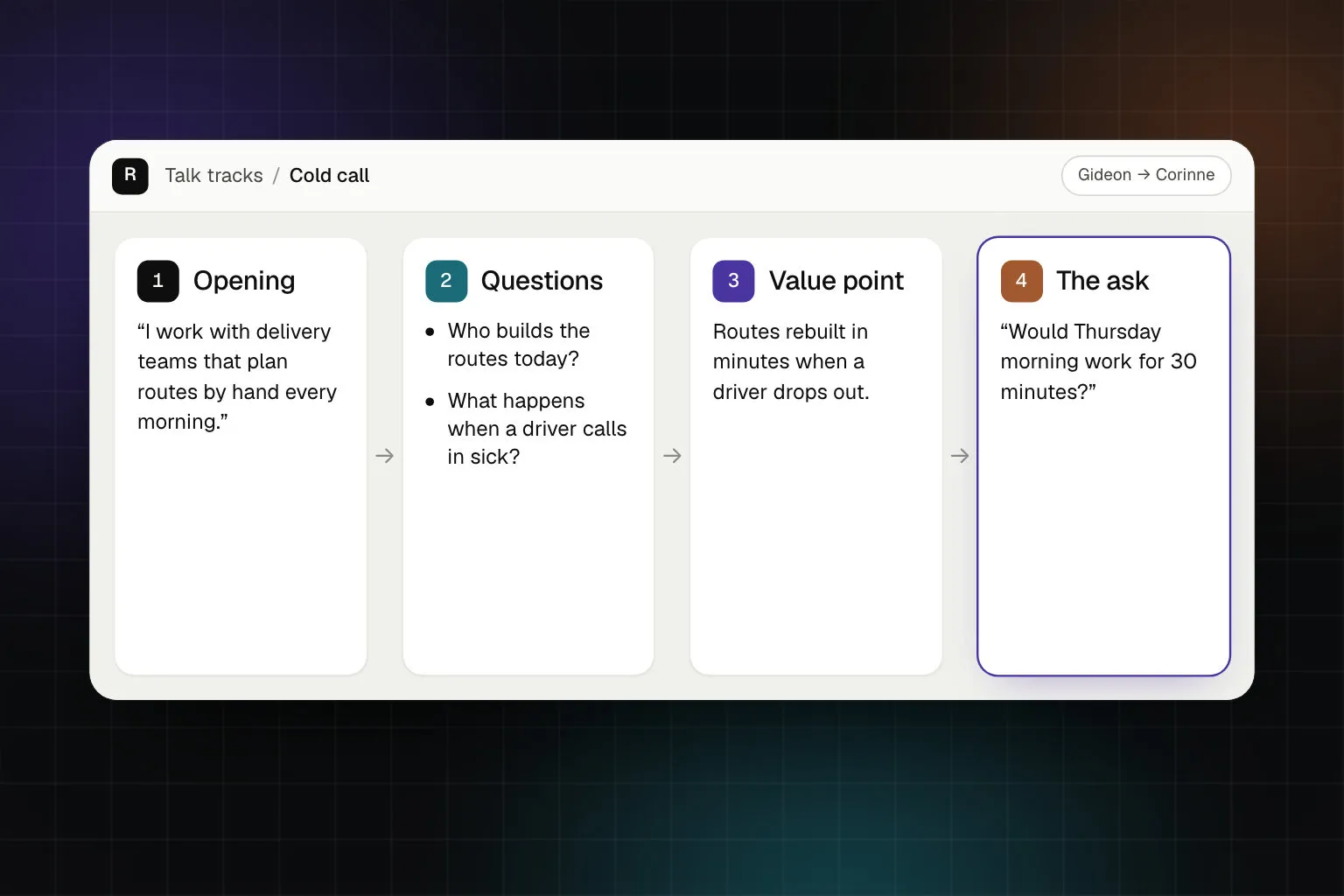
Example 1: cold call
Goal: a 30-minute discovery call with Corinne, the operations director, this week or next.
Buyer: operations director at a regional delivery company · cares about on-time delivery and overtime · usually struggles with routes planned by hand each morning.
Opening: “Corinne, this is Gideon. I work with delivery teams that plan routes by hand every morning. How is that going for you at the moment?”
Questions: Who builds the routes today, and how long does it take? What happens when a driver calls in sick? Where do late deliveries show up first: customers, overtime or both?
Value point: routes rebuilt in minutes when a driver drops out, not by phone calls before 7 a.m.
Likely objection: “Send me an email.” → “Happy to. To make sure I send something useful, can I ask one question first? Is late delivery a problem this quarter, or not a priority right now?”
The ask: “Would Thursday morning work for 30 minutes to see how your routes would look?”
Example 2: discovery call
Goal: agree on a demo built on Corinne’s own routes, with her fleet manager Darnell in the room.
Buyer: Corinne again, now with time set aside · cares about a plan she can defend to her CEO · usually struggles with tools her dispatchers stop using.
Opening: “Thanks for the time. I’d like to spend most of it on how your mornings work today, then tell you whether we can help. Does that work?”
Questions: Walk me through yesterday morning, from the first order to the last van out. Where did the plan change? What did that change cost: overtime, a missed window, a complaint? If routes rebuilt themselves, what would your dispatchers do with that time?
Value points: fewer late deliveries from re-planning on the fly; dispatchers who start the day with a plan instead of building one.
Likely objection: “We tried a tool like this and nobody used it.” → “That’s worth knowing. What made people stop?” → answer on rollout and training, not on features.
The ask: “If you send me last week’s orders, we’ll show you your own routes. Can Darnell join on Tuesday?”
Example 3: price objection
Goal: keep the price, or change it only in exchange for something, and book a call with the person who signs.
Buyer: Hollis, finance lead · cares about this year’s budget · usually compares quotes line by line.
Opening: “Thanks for saying it straight. When you say too expensive, is that compared with another quote, or with the budget you have?”
Questions: What does the other quote include? What result would make this worth the price for you? What happens if nothing changes this year?
Value point: the result Hollis just named, set against what each offer actually includes.
Don’t: offer a discount before you know what the price is being compared with.
The ask: “Could we put both quotes side by side with your CFO on Friday?”
A price objection is the hardest of the three to run from a page, because the buyer rarely says the real reason first. Nia · AI head of field operations holds a competing quote and a reason she won’t mention until you ask the right question: try a price objection conversation with Nia before a real buyer. To make the answers automatic, use these drills for handling objections.
The talk track we learned the most from was for discovery calls. The first version was a full page: a long opening, a dozen questions and every feature we had. Reps read it, and buyers cut in before the second question. We kept the opening, four questions and one ask, and dropped the rest. Then each rep ran it out loud against a colleague playing a tough buyer before the next week of calls. The difference showed on the first calls: reps listened, asked follow-ups and ended with a date in the calendar. Shorter and rehearsed beats complete and read. Pick one call type and try it with your team.
How to rehearse a talk track with AI
A talk track on paper has never met a buyer. Without rehearsal, reps find its gaps on real calls, where each gap costs a meeting. A colleague playing the buyer helps, but colleagues are busy and go easy on each other. With The Reflection, reps rehearse calls with AI buyers and get scored on each one. The rep talks to an AI buyer by voice or video and runs the call from their talk track. After each run the rep gets a score for every criterion, with the lines that earned or lost points and timestamped comments. The criteria can follow your own methodology, such as MEDDIC, SPIN or your playbook.
Take Nia’s price objection. A rep whose talk track goes straight to a discount loses points and sees the line where it happened. On the next run they ask the question first. Start from the sales scenarios to rehearse your talk track on, or have one built around your product, pricing and the buyers your reps meet.
How to tell your talk track works
Not by how complete it looks. Watch a rep run it against a buyer who pushes back, and check four things:
- The rep leads the conversation by the plan, not by the page. They paraphrase, follow the buyer and come back to the next point.
- The questions get answers the rep uses. Later in the call, the value points are in the buyer’s words.
- Objections are acknowledged before they are answered. No defense in the first sentence.
- The call ends with the ask. A dated next step, not a promise to send information.
If several reps fail the same check, fix the talk track, not the reps. For the full picture, here is how to tell when a rep is ready for real calls.
Common talk track mistakes
- Reading it like a script. Buyers hear it in the first sentence. Write points, not paragraphs, and rehearse until the rep does not need the page.
- An opening that is too long. If the buyer has not spoken by the end of your opening, it is a pitch. End the opening with a question.
- No questions, or questions as a formality. A talk track that goes from opening to features skips the part where the buyer tells you what to sell.
- Too many value points. A rep who mentions everything leaves the buyer to decide what matters.
- No next step. “I’ll send you some information” is not a next step. Write the ask, with a date, as the last line.
Sources
- Neil Rackham. SPIN Selling. McGraw-Hill, 1988.