
On this page
- Sales readiness means a rep can handle the conversations of the job, not that they finished the training.
- Measure it in conversations: three to five roleplays for the role, scored on the criteria of your sales method.
- Take a baseline, set the threshold before anyone is tested, and measure again after practice.
- Sort reps into ready, close and not yet, then check the scores against what happens in the field.
What sales readiness is
Sales readiness is the point at which a rep can handle the real conversations of their role on their own: open a cold call, run discovery, answer a price objection, negotiate terms. It combines three things: knowledge of the product and the buyer, the skill to use that knowledge in a live conversation, and the behavior that holds up when the buyer pushes back.
The key word is handle. Most programs count what went in: hours of training, modules completed, a product quiz passed. Those are inputs. Readiness is an output, and it shows in what the rep actually says when a buyer asks the hard question. A rep can ace the product quiz and still give away a discount the first time a CFO says the price is too high.
One note before we go on: in some marketing glossaries, “sales readiness” means how ready a lead is to buy. This article is about the seller.
Sales readiness vs sales enablement
The two terms are often used as one, but they answer different questions. Sales enablement gives reps what they need to sell: content, playbooks, tools and training. Sales readiness checks that reps can use all of it in a conversation with a buyer.
| Sales enablement | Sales readiness | |
|---|---|---|
| Question it answers | Do reps have what they need? | Can reps use it with a buyer? |
| What it produces | Playbooks, battle cards, content, courses | A decision for each rep: ready, close or not yet |
| How it is measured | Content usage, course completion | Scores on conversations against agreed criteria |
| When it happens | Continuously, across the role | Before a rep meets buyers, and again when the product, pricing or segment changes |
Enablement without readiness is a map handed over with no check that anyone can find the way. The rest of this article is about the readiness side: what to measure, where to set the bar and how to see whether it holds in the field.
What to measure: conversations, not quizzes
A quiz shows what a rep knows. A conversation shows what they do with it when a buyer interrupts, doubts and changes the subject. So the unit of measurement is a conversation, and the set of conversations depends on the role. Pick the three to five that decide deals in your sales motion:
- Cold call. Earn the next ten minutes and a meeting.
- Discovery. Uncover the problem, what it costs and who decides.
- Price objection. Hold value when the buyer says it costs too much.
- Negotiation. Trade concessions for commitments instead of giving discounts away.
- Renewal or upsell, for account managers.
An SDR may need only the first two. An account executive needs all four. Measure only what reps have been taught: if they don’t yet know what to say, build the talk track before you test it, and if objections are where deals stall, start with drills for the objections reps practice.
Then score each conversation against the sales method your team already uses, so reps are measured on the same language their managers coach in. Two common choices. MEDDIC is a widely used qualification framework: metrics, economic buyer, decision criteria, decision process, identify pain and champion. SPIN sorts discovery questions into situation, problem, implication and need-payoff, and comes from Neil Rackham’s research into how larger sales are won1.
Here is what the criteria can look like for a discovery call built on SPIN:
- Asks about the buyer’s situation only as far as needed, without a long list of facts they could have looked up.
- Uncovers at least one problem in the buyer’s own words.
- Asks what the problem costs and who else it affects.
- Gets the buyer to say what solving it would be worth, instead of pitching the value.
- Finds out who else is involved in the decision and how it will be made.
- Ends with a next step the buyer agrees to, with a date.
Every criterion is scored on what the rep said: the questions asked, the answers given, the commitment secured. That keeps the score about a skill you can coach, and it makes the score easy to explain to the rep.
A short training example. Callum, a new account executive, runs discovery with Harriet · AI VP of finance:
- Harriet
We already have a process for this. I’m not sure why we’re talking.
- Callum
Fair question. How does it work today when a quarter closes?
- Harriet
Three people pull the data into spreadsheets. It takes most of a week.
- Callum
What does that week cost you? In delays, or in decisions made late?
- Harriet
The board pack goes out late every quarter. Our CEO has noticed.
- Callum
If the pack went out on time, what would that change for you?
Callum moved from situation to implication in two questions and let Harriet name the value herself. On the list above, he meets criteria 1 to 4. Whether he is ready for discovery depends on the rest of the call: does he find out who signs off, and does he leave with a date?
On The Reflection, sales teams practice the conversations reps will face, scored on your criteria: an AI buyer built from your product, pricing and battle cards, by voice or video, with per-criterion scores and timestamped comments after every run.
A sales readiness assessment in three steps
A sales readiness assessment does not need a big program. It needs the same scenarios, the same criteria and three moments in time.
Step 1: Take a baseline
Before any training, every rep runs the scenarios for their role once, without coaching. This gives you a starting point for each rep and each criterion, and it often shows the gaps are not where you assumed. A team that “needs negotiation training” may be losing deals earlier, in discovery.
Three scenarios are enough to start: one for each conversation that decides deals in the role. Past five, the assessment turns into a training program.
Step 2: Set the threshold before anyone is tested
Decide what “ready” means before you see the scores. Otherwise the bar drifts toward whoever you already think is good. The threshold is set by the sales leader who owns the number, together with enablement or L&D, and it has two parts:
- A score for each scenario that counts as ready.
- A few must-have criteria that override the score. For example: never quote a discount before the buyer has named the problem, and never end a call without a next step.
Write it down and share it with the reps. A rep who knows what ready looks like gets there faster.
Step 3: Measure again
After practice, reps run the same scenarios, scored the same way. The two runs side by side show who moved, on which criteria, and where the training didn’t land. Measure again at three points: at the end of a training cycle, before a rep’s first solo calls, and whenever the conversation changes, such as a new product, a price increase or a new segment. For new hires, the same checks fit into the first weeks on the job, as readiness checks inside new hire onboarding.
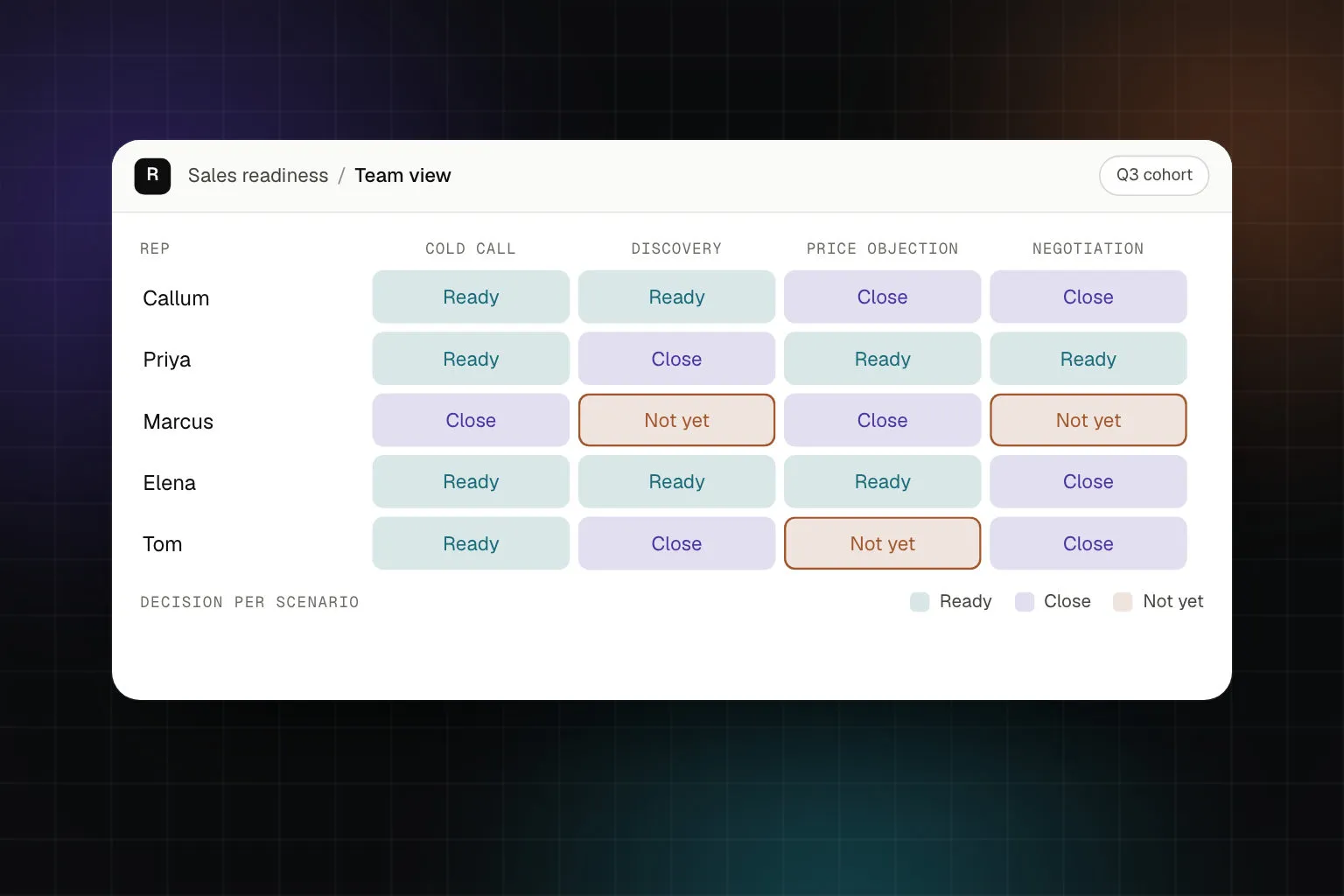
Ready, close, not yet
Turn the scores into a decision a manager can act on. Three levels are enough. With more, people argue about the borders. With two, you lose sight of the reps who are one practice session away.
| Level | Scores on criteria | Decision | What to do next |
|---|---|---|---|
| Ready | At or above the threshold in every scenario, every must-have met | Takes this type of conversation with real buyers | Review a few real calls in the first weeks; measure again when the product or pricing changes |
| Close | At the threshold overall, one or two criteria below it, no must-have missed | Goes live with a safety net | Assign the scenario that targets the weak criterion; the manager reviews the first real calls; measure again in two weeks |
| Not yet | Below the threshold in one or more scenarios, or a must-have missed | Doesn’t take this type of conversation alone yet | Practice plan on the gaps; shadow or co-sell; assess again before any solo call |
The decision is made for each type of conversation, not for the person as a whole. A rep can be ready for discovery and not yet for negotiation. That is useful: they can start booking and running first meetings while a senior colleague handles the commercial terms.
The hardest call is the rep who aces the product exam and wants to go out now. We have let a rep like that start before he passed the price conversation. Discovery went well. Then the first buyer asked for a discount, and he gave it in the same call, before anyone had talked about value. Since then our rule is simple: a missed must-have means not yet, however strong the rest looks. Reps push back for a few days, then practice the scenario until it holds. The ones who wait go out better prepared and close cleaner. We would rather lose a few days than the margin on a key account.
Connecting practice scores to the field
A readiness score is only worth having if it predicts what happens with real buyers. Kirkpatrick’s model of training evaluation gives a simple frame: level 1 is reaction, level 2 is learning, level 3 is behavior on the job and level 4 is results2. Many sales programs stop at the first two, with a satisfaction survey and a quiz. Readiness belongs at level 3, and it should be checked against level 4.
- Level 3, behavior. Do reps do in real calls what they did in practice? Score a sample of recorded calls or field visits on the same criteria as the roleplays and compare. In the CRM, look for traces of the behavior: next steps logged with a date, decision makers named, qualification fields filled in.
- Level 4, results. Look at conversion at the stage where the conversation happens (discovery to proposal, proposal to close), discount levels on deals with price pushback, win rate, and time to first deal for new hires.
Then compare reps who went out as ready with those who went out as close or not yet over the same period, criterion by criterion. If ready reps do no better in the field, the threshold or the criteria are wrong. Fix the assessment, not the reps.
This comparison is much easier when practice and real calls share one scorecard. On The Reflection, uploaded call recordings are scored on the same competency model as the roleplays.
Why it is worth the effort: getting a rep to full productivity takes a long time. Bridge Group’s 2026 research puts the average ramp time for account executives at 6.2 months, the highest in the study’s history3. Sending reps to buyers when they are ready, and not before, protects the deals they touch during those months.
Example: 500 medical reps, field-ready in 3 days
A pharmaceutical company had to prepare more than 500 medical representatives for a new drug launch with a fixed date. Live roleplays with trainers would have taken weeks and pulled trainers and managers out of the field.
Instead, reps practiced with an AI physician who asked about the clinical data and raised the objections doctors have about a new treatment. Every conversation was scored on the launch messaging, so it was clear who delivered the key messages and who needed another run.
The reps were field-ready in three days, down from weeks, and sales in trained territories were 28% higher. Read how 500 medical reps got field-ready in 3 days.
The lesson for any sales team: once readiness is defined as a scored conversation, you can check it for hundreds of people in days. Trainer time stops being the bottleneck.
How to start
You don’t need a company-wide program to begin. Start with one team and three conversations.
- Pick the team and the conversations that decide deals for them.
- Write the criteria from your sales method or competency model, and agree on the threshold and must-haves before anyone is tested.
- Baseline, practice, measure again, then compare the scores with field results.
On The Reflection, you can start the same way: one team on the Team plan, scenarios built on your competency model, and per-skill analytics to compare with field results. Seats are added as more teams join; see per-seat pricing for the Team plan.
Sources
- Neil Rackham. SPIN Selling. McGraw-Hill, 1988.
- James D. Kirkpatrick and Wendy Kayser Kirkpatrick. Kirkpatrick’s Four Levels of Training Evaluation. ATD Press, 2016.
- Bridge Group. AE Models, Motions & Metrics: 2026 Research Report. June 2026.