
On this page
- AI phone screening is a short call from an AI voice that asks every candidate the same basic questions and sends the recruiter a summary.
- An AI interviewer runs a structured first-round interview, follows up on vague answers and scores each skill with quotes from the conversation.
- Use a screen to check logistics at volume. Use an interview when the job depends on how people think and talk.
- Before rolling either one out, check disclosure, consent and bias audit rules where you hire.
What AI phone screening means in hiring
First, what this is not. Phones now have a call screening feature that answers unknown numbers for you. That is a different thing. In hiring, AI phone screening means an AI voice calls a candidate, or takes their call, and runs the first short conversation a recruiter used to make.
The call usually goes like this:
- The AI introduces itself and the job the candidate applied for.
- It asks the same basic questions to everyone. When can you start? What pay do you expect? Are you authorized to work in this country? Can you work the shifts this role needs?
- It records the answers and asks the candidate to repeat or clarify when it did not catch one.
- The recruiter gets a summary of each call and decides who moves on.
That is the strength of the format: it is quick, it is the same for every candidate, and it takes a stack of yes-or-no checks off the recruiter’s desk. It is also the limit. The questions have one right answer. A screen tells you whether someone can take the job, not how well they would do it.
What an AI interviewer does
An AI interviewer replaces a different step: the first-round interview, where a recruiter asks about past work and listens for skills. On The Reflection, it is a structured first-round interview scored skill by skill. Here is how it works:
- One link, any device. The candidate opens the interview from a phone or laptop when it suits them, with no scheduling. They talk by voice or on video.
- Your questions, the same for everyone. You set the questions, the follow-up rules, the tone and the language, then every candidate for the role gets the same interview.
- Follow-up questions. When an answer stays general, the AI asks for a real example, the way a good recruiter would.
- A short roleplay. Candidates can handle a realistic situation inside the interview, such as an upset client, so you see what they do, not only what they say they do.
- 50+ languages. Candidates answer in their own language and are scored on the same model.
- Scores with evidence. Each skill gets a score, and every score links to the quotes and timestamps it is based on.
- People decide. The AI recommends. Recruiters and hiring managers decide who moves forward.
Candidates know they are speaking with an AI interviewer before they start, and interviews are never used to train any model.
Here is how a follow-up sounds. This is an illustrative example for a customer support lead role.
- AI interviewer
Tell me about a time you had to say no to a customer.
- Marisol
That happens a lot in support. I always try to stay polite and explain the policy.
- AI interviewer
Can you walk me through one specific case? Who was the customer, and what did you say?
- Marisol
A clinic wanted a refund after their trial ended. I couldn’t give one, so I offered to extend the trial two weeks and set up a call with their admin. They stayed.
The first answer is what a phone screen would record. The second is what a recruiter needs to judge the skill, and it is the line a score can quote.
AI phone screening vs AI interviewer, side by side
These are categories, not products. Tools differ, so check the details with any vendor you consider.
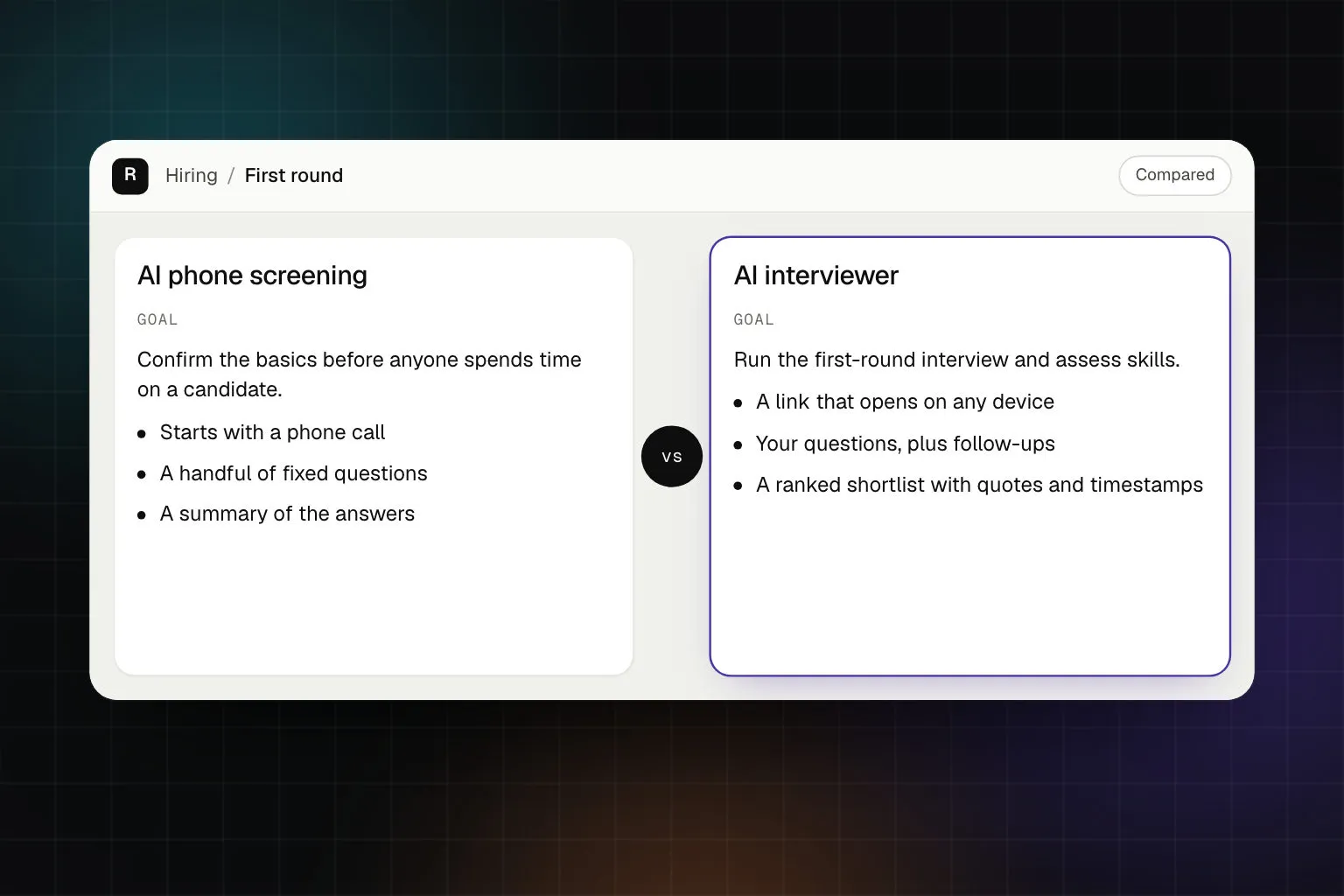
| Compared on | AI phone screening | AI interviewer |
|---|---|---|
| Goal | Confirm the basics before anyone spends time on a candidate | Run the first-round interview and assess skills |
| How it starts | A phone call | A link the candidate opens from any device |
| Length | Short: a handful of fixed questions | A full first-round conversation |
| Questions | Fixed questions with one right answer | Your interview questions, follow-ups when an answer is vague, a short roleplay |
| What is assessed | Whether the candidate meets the basic requirements | Skills you define, scored against your rules |
| What the recruiter gets | A summary of the answers | A ranked shortlist with the quotes and timestamps behind each score |
| Where it fits | High-volume roles with simple requirements | Roles where how people think and talk matters |
The difference is the type of question. A screen checks facts. An interview collects evidence. Structured interviews, where every candidate gets the same questions and the same scoring rules, came out as the top-ranked selection procedure in a large 2022 re-analysis of hiring research1. A screen is not built to do that job, and it does not try to.
Which one you need
Start from what the role demands, not from the tool.
- High-volume hiring with simple requirements. Warehouse shifts, seasonal staff, roles where availability and a license matter more than anything said in an interview. A short screen does the job.
- Roles where conversation is the work. Sales, customer success, support, graduate programs, team leads. A screen will pass people who meet the requirements and say little about how they handle a customer. Here you need an interview.
- Both. Many teams check basics in the application form and give everyone who passes a structured interview.
Be clear about what you are buying. If you need an AI that calls candidates’ phones, that is a phone screening tool. The Reflection does not call candidates. Our AI interviewer works from a link, by voice or video, on any device, and its job is a structured interview with scores you can check. The skill model is not limited to hiring: with the same scoring used for current employees’ skills, you can compare candidates with the people already on the team.
When a recruiting team first asks us to build an AI interviewer, their question list often looks like a phone screen: when can you start, what salary do you expect, can you work weekends. Those questions belong in the application form. They have one right answer and need no conversation. The interviewer earns its place on the question recruiters used to save for the second call: tell me about a customer you couldn’t help. Once the interview is built around two or three questions like that, each with a follow-up rule, hiring managers start reading the shortlist instead of asking for another call. Bring one job description to a demo and we’ll build that interview with you.
What it feels like for the candidate
For the candidate, the two formats feel different from the first second.
A phone screen arrives as a call. Some candidates are glad to answer three questions and move on. Others are caught off guard by an AI voice on a call they expected from a person, and in the US a call from an AI voice generally needs the candidate’s consent (see the checklist below).
An AI interview starts when the candidate chooses. They open the link, see that it is an AI interview before they begin, and answer in their own words, at home, in the evening, on their phone. Because the AI follows up, a nervous first answer is not the end: they get a second chance to give a real example.
Whichever format you choose, tell candidates up front that they will talk to an AI, what it will ask about and who reads the results. If they want to rehearse, point them to how candidates can prepare for an AI interview.
What HR should check before rolling either one out
Both categories use AI to evaluate candidates, so many of the same rules can apply to both. A phone screen has one more: it calls people. Here is what to check with your legal team. This is not legal advice.
- EU: high-risk systems. The AI Act lists AI used to filter job applications and evaluate candidates as high-risk2. The obligations for these systems apply from December 2, 20273. Ask any vendor how they are preparing for them.
- EU: no emotion reading. Since February 2, 2025, the AI Act bans AI systems that infer a person’s emotions in the workplace, except for medical or safety reasons2. Neither a screen nor an interview should judge a candidate’s stress, confidence or mood from their voice or face. The Reflection scores what candidates say, not how they sound or look.
- EU: tell people it is AI. From August 2, 2026, an AI system that talks directly with people must let them know they are talking to AI, unless it is obvious from the context2.
- New York City: bias audit and notice. If an automated tool helps assess candidates for a job in the city, it needs an independent bias audit within the past year, with a summary published on your website. Candidates who live in the city must get notice at least 10 business days before the tool is used, including what it will assess and how to request an accommodation4.
- Illinois: video interviews. For positions based in Illinois, if you ask applicants to record video interviews and analyze them with AI, you must tell each applicant before the interview, explain how the AI works and what it evaluates, and get their consent. Without consent, AI cannot be used to evaluate them5.
- US: AI voices on calls. In February 2024 the FCC confirmed that AI-generated voices count as “artificial” voices under the Telephone Consumer Protection Act, so calls that use them need the called person’s prior express consent unless an exemption applies6. This one is specific to phone screening.
- Data. Ask where interviews are stored, who can see them and whether they are used to train models. On The Reflection, here is how candidate data is handled.
Questions recruiters ask
Does an AI phone screen replace the recruiter?
No. It takes over the routine first call and hands the recruiter a summary. Someone still has to read it and decide who moves on. The same goes for an AI interviewer: it recommends, and hiring decisions stay with your team.
Can candidates tell they are talking to AI?
They should not have to guess. Tell them before the conversation starts, and in the EU this is a legal requirement from August 2, 2026. On The Reflection, the interview is introduced as an AI interview before the candidate begins.
Sources
- Paul R. Sackett, Charlene Zhang, Christopher M. Berry and Filip Lievens. Revisiting meta-analytic estimates of validity in personnel selection: Addressing systematic overcorrection for restriction of range. Journal of Applied Psychology, 107(11), 2040–2068, 2022.
- Regulation (EU) 2024/1689 (Artificial Intelligence Act), Article 5(1)(f), Article 50(1) and Annex III, point 4. Official Journal of the European Union, July 12, 2024.
- Regulation (EU) 2026/1744 (Digital Omnibus on AI). Official Journal of the European Union, July 24, 2026.
- NYC Department of Consumer and Worker Protection. Automated Employment Decision Tools: Frequently Asked Questions. June 29, 2023.
- Illinois General Assembly. Artificial Intelligence Video Interview Act, 820 ILCS 42, Section 5.
- Federal Communications Commission. Implications of Artificial Intelligence Technologies on Protecting Consumers from Unwanted Robocalls and Robotexts, Declaratory Ruling, FCC 24-17. Released February 8, 2024.