
On this page
- Ask about one behavior the reviewer has actually seen, not about a trait.
- Pair every rating with an open question and a follow-up probe. The rating tells you how much, the probe tells you why.
- Keep it short: a handful of competencies, or five questions if that is all you have room for.
Most lists of 360 feedback questions stop at the rating scale. You get “3 out of 5” on communication and no idea what to do with it. Below are questions for eight competencies, each with a rating statement, an open question and a follow-up probe that asks for an example. There are separate sets for managers, peers and self-assessment, and a short version for when you only have room for five.
The questions are our examples, not a validated instrument. Adapt the wording to your own competency model.
How to write a good 360 question
A good 360 question asks about something the reviewer could see. A peer cannot judge how someone runs one-to-ones with their team. A direct report cannot judge how they handle the leadership meeting. Six rules cover most of it:
- One behavior per question. “Communicates clearly and listens well” is two questions. A reviewer who agrees with half of it has no right answer.
- Behavior, not character. “Is confident” or “has a positive attitude” asks for a judgment of the person. “States a position in meetings and explains the reasoning” asks about what they do.
- No loaded words. “Always,” “never,” “excellent” and “poor” push the answer before the reviewer has thought about it.
- Only what the reviewer has seen. Add a “Not observed” option, so people do not guess.
- A time frame. “In the last six months” keeps answers about recent work, not a reputation from three years ago.
- Plain words. If a question needs a definition, rewrite it.
“Is a strong leader who communicates well.”
“Explains the reasons behind a decision, not only the decision.”
Rating questions vs open questions
A rating question gives you comparison: across competencies, across reviewers, from one cycle to the next. An open question gives you the reason. You need both, and research on performance ratings shows why a rating on its own is a weak basis for decisions.
Scullen, Mount and Goff studied developmental ratings of two large groups of managers, 2,350 and 2,142 people. Each manager was rated on three dimensions by two bosses, two peers, two direct reports and themselves. The raters’ own rating tendencies explained 62% and 53% of the variance in the ratings. The managers’ actual performance, overall and on the specific dimension, explained 21% and 25%1.
In other words, a score says more about the person giving it than about the person receiving it. A rating with an example behind it is easier to trust, because you can check whether the example supports the number.
The rule for your questionnaire follows from that: in every competency, at least one open question and one follow-up probe. The rating tells you where to look. The example tells you what to change.
360 feedback questions by competency
Each competency below has a statement to rate on a 1–5 agreement scale, an open question and a probe to use when the answer is vague. Pick the competencies that match your model. If what you need is to map skill gaps across a team rather than give one person feedback, start there instead.
Communication
| Rating statement | Open question | Follow-up probe |
|---|---|---|
| Explains the reasons behind decisions, not only the decisions. | When did this person explain something in a way that changed how you worked? | What did they say that made it clear? |
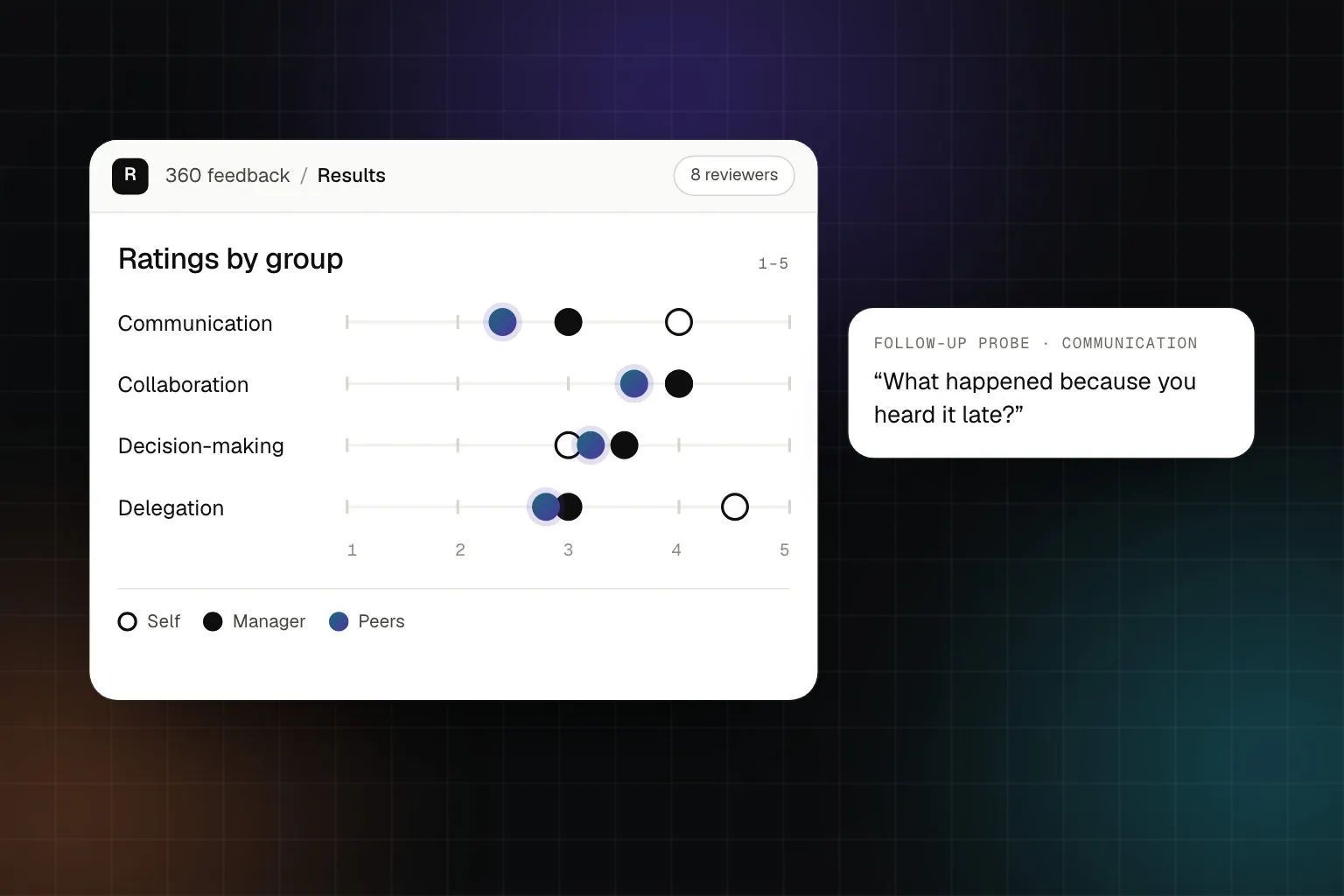
| Shares information the team needs before it is needed. | What do you wish you had heard from them earlier? | What happened because you heard it late? |
| Listens to the end before responding. | How do they react when you raise a concern? | What did they do the last time you disagreed with them? |
Collaboration
| Rating statement | Open question | Follow-up probe |
|---|---|---|
| Keeps commitments made to other teams. | What happens when a shared deadline is at risk? | Can you describe the last time that happened? |
| Gives credit to the people who did the work. | Where has working with this person made your job easier? | What exactly did they do, and when? |
Decision-making
| Rating statement | Open question | Follow-up probe |
|---|---|---|
| Makes decisions on time, even with incomplete information. | Which of their decisions from the last six months would you hold up as an example? | What did they weigh before deciding? |
| Involves the people affected before a decision is final. | When did one of their decisions take you by surprise? | Who could have been asked first, and what would that have changed? |
Delegation
| Rating statement | Open question | Follow-up probe |
|---|---|---|
| Delegates whole outcomes, not only tasks. | What have they handed over to you recently, and how? | What did they keep control of that you could have owned? |
| Agrees on how and when to check in, then sticks to it. | How do they follow up on work they have delegated? | What did the last check-in look like? |
| Gives people work that stretches them. | What is the most challenging piece of work they have given you? | What support did you get along the way? |
Handling conflict
| Rating statement | Open question | Follow-up probe |
|---|---|---|
| Raises disagreements directly with the person involved. | How do they handle a disagreement within the team? | What happened the last time, and how did it end? |
| Keeps the discussion on the issue, not the person, when tension rises. | When have you seen them in a tense meeting? | What did they say or do next? |
| Brings open conflicts to a decision instead of letting them drag on. | Is there a disagreement on the team they have left unresolved? | What would resolving it have taken? |
Accountability
| Rating statement | Open question | Follow-up probe |
|---|---|---|
| Owns mistakes openly, including in front of their team. | What happens when something they are responsible for goes wrong? | Can you describe one case and what they did afterward? |
| Delivers what they commit to, or warns early when they can’t. | How much can you rely on a date they give you? | When did they last flag a risk early, and how? |
Strategic direction
| Rating statement | Open question | Follow-up probe |
|---|---|---|
| Connects the team’s work to the organization’s goals. | How well do you understand where your team is heading this year? | What did they say or do that made it clear, or unclear? |
| Stops work that no longer fits the priorities. | What should this person stop doing to focus on what matters most? | What would that free up for the team? |
| Plans beyond the next quarter. | Which longer-term bet of theirs do you understand, and which don’t you? | What would help you explain it to someone else? |
Adaptability
| Rating statement | Open question | Follow-up probe |
|---|---|---|
| Adjusts plans when circumstances change, without losing the goal. | How did they respond the last time a plan had to change? | What did they keep, and what did they drop? |
| Is open to approaches different from their own. | When did they change their mind because of someone else’s idea? | What convinced them? |
Questions for managers
These are upward questions: direct reports answer them about their manager. They cover what direct reports experience firsthand: clear goals, feedback and support for growth.
- My manager makes clear what is expected of me and how my work will be judged.
- I understand how my work connects to the team’s priorities.
- My manager gives me feedback often enough that my review holds no surprises.
- When my manager gives critical feedback, it is specific enough to act on.
- My manager helps me build the skills I need for my next step.
- I can raise a problem or disagree with my manager without it being held against me.
- My manager removes obstacles I cannot remove myself.
- Open: What is one thing your manager could do differently that would help you do your best work?
Once the report is in, someone has to talk it through with the manager. Keep that conversation on specific behaviors and their impact; these are ways to phrase critical feedback so it can be acted on.
Questions for peers and self-assessment
Peers see how someone works across the team: whether they share information, keep commitments and give credit. Ask the person being reviewed the same questions in the first person, so you can put the two sets of answers side by side.
- Peer: Shares information I need to do my work. Self: I share the information other people need to do their work.
- Peer: Keeps the commitments they make to me. Self: I keep the commitments I make to colleagues.
- Peer: Is easy to disagree with. Self: People find it easy to disagree with me.
- Peer: Gives credit to the people who did the work. Self: I give credit to the people who did the work.
- Peer: Asks for help early instead of waiting until a deadline slips. Self: I ask for help early instead of waiting until a deadline slips.
- Peer: Gives me useful feedback on my work. Self: I give colleagues useful feedback on their work.
- Self, open: What is one thing you would like colleagues to tell you that they probably don’t?
The useful part is the gap. If someone rates themselves a 5 on “people find it easy to disagree with me” and their peers give a 2, that gap is where the development conversation starts.
Open-ended questions that get useful answers
Good open questions ask about a specific behavior in a specific period. “Any other comments?” collects very little. These work for any reviewer group:
- What should this person keep doing, because it helps you?
- What is one thing they could do differently that would make the biggest difference to your work?
- Describe a moment in the last six months when they were at their best. What did they do?
- When was working with them hardest? What happened?
- What do they do that others on the team could learn from?
- What would you want them to ask you about more often?
- If they took on a bigger role next year, what would they need to do differently?
Good questions are half the job; the other half is the answers. Share a short guide with reviewers on how to write the answers so they are specific and kind.
If you only have room for five
A short pulse, a small team or a first 360 does not need 20 statements. These five cover the most ground:
- This person explains the reasons behind their decisions (rating). Every reviewer group can see it, and it covers both communication and decision-making.
- This person keeps the commitments they make (rating). Accountability, visible to peers, direct reports and managers alike.
- I can raise a problem with this person without it being held against me (rating). It tells you whether people bring them bad news early.
- What should this person keep doing? (open). It names strengths in the reviewer’s words, so the report is not only a list of problems.
- What is one thing they could do differently that would help you most? (open). One change, chosen by the reviewer, is easier to act on than a long list.
Follow-up questions that turn a rating into an example
A second rating scale adds another number with the same rater effects as the first. A follow-up adds evidence. These probes work after almost any rating or vague answer:
- “What did that look like the last time you saw it?”
- “What would a 5 look like?”
- “Why not one point higher?”
- “Can you give one example from the last three months?”
- “What happened as a result?”
- “What would you want them to do instead?”
In a written survey, put the probe right under the rating as an optional comment: “If you rated this 3 or lower, what would a 5 look like?”
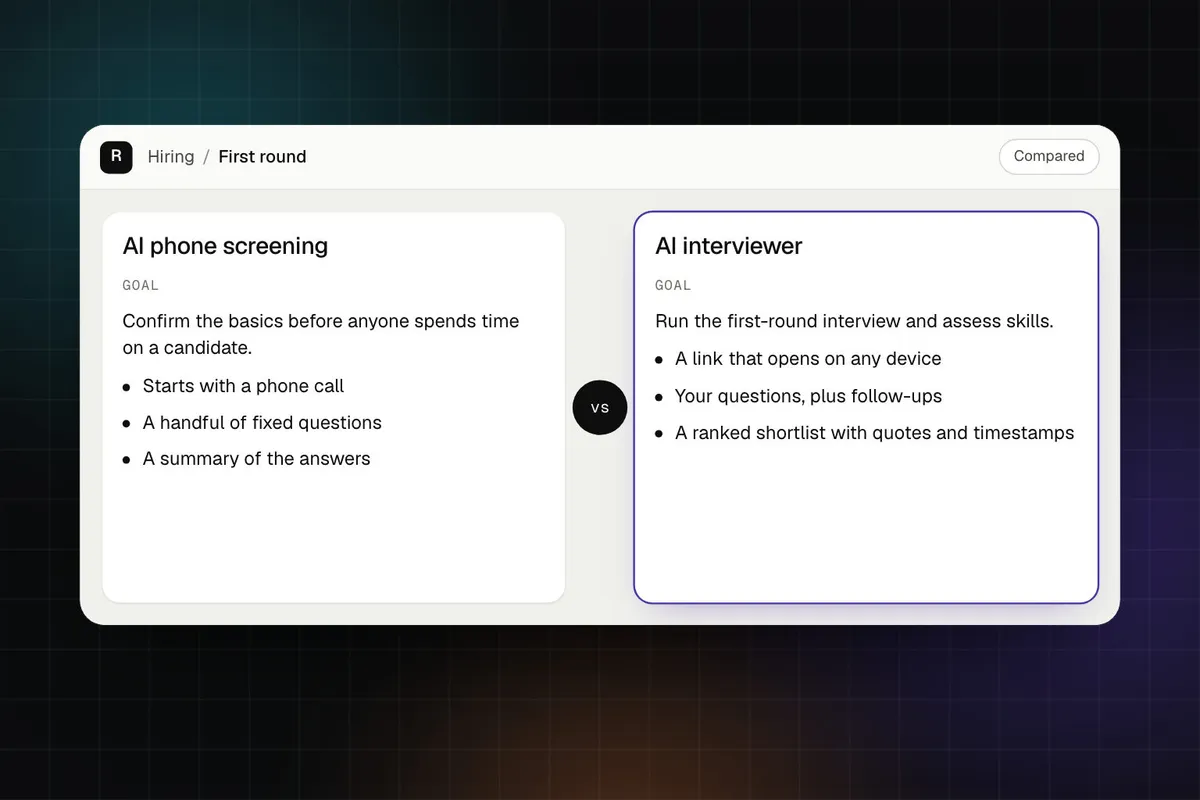
In a 360 review run as an AI interview, reviewers have a spoken conversation instead of filling in a form. The AI interviewer asks at what level a competency shows up, then asks for a specific example. If a reviewer gives a rating, it asks why the rating is not higher, or asks for an example. The probes above are the same idea, built into the conversation.
The probe that does the most work is the plainest one: “What did that look like the last time you saw it?” A reviewer who wrote “communicates well” usually has a meeting or a message in mind. The question gives them permission to describe it, and the vague score turns into a scene the manager can recognize. The question we stopped using is “Any other comments?” It collected thank-yous and repeats of earlier answers, rarely anything new. When we built the 360 as a conversation, that lesson went straight in: every rating is followed by a request for an example, never by another scale. Try it on one team and compare the reports.
Mistakes that make 360 answers useless
- A questionnaire that is too long. Eight competencies with three statements each is 24 ratings per person reviewed. A reviewer with five colleagues to review faces 120. Cut statements before you add open questions.
- Questions about traits instead of behavior. “Is a good listener” invites an opinion. “Lets others finish before responding” invites an observation.
- No open questions. Ratings alone carry the rater effects described above, and they never explain themselves.
- Asking everyone about everything. Peers rating strategy or direct reports rating how someone manages up produce guesses. Give each reviewer group the questions it can answer.
- No plan after the report. All the work of collecting answers is wasted if nothing follows.
Bracken and Rose name four design factors a 360 process needs to create lasting behavior change: relevant content, credible data, accountability and census participation, meaning the whole organization or unit takes part2. Good questions cover the first two. The last two depend on what happens next: who sees the results, who checks progress, and whether everyone takes part, not just a few volunteers.
A meta-analysis of 24 longitudinal studies by Smither, London and Reilly found that improvement in ratings from direct reports, peers and supervisors over time is generally small. Their review suggests improvement is more likely when people see a need to change, set goals and take action3. So agree on one or two behaviors from the report, decide how they will be practiced, and check them in the next cycle. Managers can practice the leadership skills a 360 flags in roleplay before using them with their team.
A common criticism of 360 feedback is that it produces scores nobody can explain. A follow-up closes that gap, whether a colleague asks it or a 360 review run as an AI interview does.
Questions HR teams ask
What are some good feedback questions to ask?
Questions about one specific behavior, in a recent time frame, that the reviewer has actually seen. “What should this person keep doing?” and “What is one thing they could do differently that would help you most?” work in almost any 360. Follow each answer with a request for an example.
What are 5 good survey questions?
Three rating statements every reviewer can observe and two open questions. A ready set is in If you only have room for five.
Sources
- S. E. Scullen, M. K. Mount and M. Goff. Understanding the latent structure of job performance ratings. Journal of Applied Psychology, 85(6), 956–970, 2000.
- David W. Bracken and Dale S. Rose. When does 360-degree feedback create behavior change? And how would we know it when it does? Journal of Business and Psychology, 26(2), 183–192, 2011.
- James W. Smither, Manuel London and Richard R. Reilly. Does performance improve following multisource feedback? A theoretical model, meta-analysis, and review of empirical findings. Personnel Psychology, 58(1), 33–66, 2005.