
On this page
- Objection handling training sticks when reps practice out loud, get scored and repeat, not when they sit through one workshop.
- Teach one response model, then drill it on five types of objections: price, timing, need, authority and trust.
- Score every attempt on the same five criteria, so reps and managers see what changed.
- Spread short practice over four weeks and re-measure at the end against the first score.
What objection handling is
Objection handling is how a salesperson responds when a buyer raises a concern that stands between them and the next step: the price, the timing, the need, who decides, or whether to trust a new vendor. Done well, it turns the concern into information that moves the deal forward.
The key shift for most reps is to hear an objection as a question, not a refusal. “It’s too expensive” usually means “I don’t yet see why this is worth more than the alternative,” or “I don’t have this budget,” or “I need something to take to my boss.” Each of those calls for a different answer, and the rep can only give the right one after finding out which it is.
Why most objection handling training doesn’t stick
Most teams already run some objection handling training: a workshop, a deck of rebuttals, a session at the kickoff. Reps leave knowing the right answers, then discount at the first push on a live call. Three things usually go wrong.
- It happens once. A single workshop teaches the idea. The skill comes from saying the words out loud many times, under some pressure, with someone pushing back.
- Reps memorize scripts. A rebuttal learned word for word works only when the buyer says exactly the expected line. Real buyers don’t. Reps need a model they can apply, not a paragraph they can recite.
- Nobody scores it. Without a score, a roleplay ends with “good job” or a vague note. The rep doesn’t know what to change, and the manager can’t tell whether anyone improved.
The fix is not a better slide deck. It is a training loop: one model, short drills, a fixed rubric and a schedule that brings reps back to the same objection after a few days.
A five-step response model
Give reps one structure for every objection. It keeps them from jumping to the answer, which is where most objections are lost.
Step 1: Listen and acknowledge
Let the buyer finish, then show you heard the concern in their words. Acknowledging is not agreeing; it buys the right to ask a question.
“Actually, if you look at the total cost of ownership, we’re very competitive.”
“Thanks for saying it straight. Too expensive compared with what?”
Step 2: Clarify
Ask one open question that makes the objection specific: compared with what, by when, for whom. Then wait for the answer.
Step 3: Find the real objection
The first objection is often not the one that matters. Keep asking until the real constraint is on the table: a budget cut, a contract that hasn’t ended, a boss who wasn’t in the demo. A good check is “If we solved that, is there anything else stopping you?”
Step 4: Answer through value
Answer the real objection, using what the buyer has already told you: their goals, their numbers, their pilot. If something has to change, such as price, terms or scope, trade it for something in return.
Step 5: Agree on a next step
End with a dated next step, ideally one that involves the person who decides. “I’ll send something over” is not a next step.
If your team already uses LAER (a trademark of Carew International) or Feel-Felt-Found, keep it. The model you train matters less than training one model consistently and scoring against it. The steps shape how a rep answers; to decide what they say about the product, build the talk track your answers sit in.
Types of sales objections to train for
Objection lists online run to dozens of lines. For training, group them by what the buyer is really saying. Five types make a practical training set. The phrases below are examples, not quotes from real calls.
| Type | What the buyer might say | What it often means |
|---|---|---|
| Price | “It’s too expensive. The other vendor is cheaper.” | The value isn’t clear yet, the budget is short, or the comparison isn’t like for like. |
| Timing | “Let’s revisit this next quarter.” | Other priorities, a contract still running, or no reason to act now. |
| Need | “We’re doing fine with what we have.” | The problem hasn’t been named, or its cost hasn’t been counted. |
| Authority | “I need to run this by my boss.” | The person who decides isn’t in the conversation, or the buyer lacks a case to take to them. |
| Trust or current vendor | “We already work with someone,” or “We tried a tool like this and it didn’t stick.” | Switching feels risky, or a past purchase failed and the buyer doesn’t want to repeat it. |
Drills for each objection type
Each drill takes five to ten minutes: one rep sells, one plays the buyer, a third person or the AI scores. The buyer holds back the real objection until the rep asks the right question.
Price: “It’s too expensive”
Setup. The buyer likes the product, holds a cheaper competing quote and has a smaller budget than last year, which they mention only when asked.
The rep’s job. Find out what the price is being compared to, discover the budget gap, compare the two offers like for like and change price only in exchange for something.
It worked if the rep didn’t offer a discount before the buyer asked for one, and the call ended with a dated meeting.
Timing: “Let’s revisit next quarter”
Setup. The buyer agrees the product fits but wants to wait. Their current contract renews automatically in two months, which they don’t mention.
The rep’s job. Ask what changes next quarter, find the renewal date and help the buyer see what waiting costs them.
It worked if the rep surfaced the renewal and agreed on a step before it, instead of booking a follow-up call in three months.
Need: “We’re fine with what we have”
Setup. The buyer’s team works around a manual process every week and doesn’t see it as a problem.
The rep’s job. Ask about the process, not the product: how long it takes, who does it, what happens when it goes wrong. Let the buyer name the cost.
It worked if the buyer, not the rep, described the problem, and the rep linked one part of the product to it.
Authority: “I need to run this by my boss”
Setup. The buyer is the user, not the person who signs. Their boss has a concern about switching costs that the buyer doesn’t raise unless asked.
The rep’s job. Find out who decides and what they will care about, then offer help building the case or a meeting with them.
It worked if the rep learned the boss’s concern and left with a meeting that includes the boss, not a promise to “pass it along.”
An illustrative exchange between two fictional people, Jonah, the rep, and Leah, the buyer:
- Leah
I like it, but I need to run this by my boss.
- Jonah
Of course. When you take it to her, what do you think she’ll ask first?
- Leah
Probably what happens to the reports we built in the old system.
- Jonah
That’s a fair worry. Would it help if I walked both of you through the migration on Tuesday, so she can ask it herself?
- Leah
Tuesday afternoon could work. I’ll check her calendar.
Jonah didn’t try to sell the boss through Leah. He found the concern, then offered a meeting where it could be answered.
Trust or current vendor: “We already work with someone”
Setup. The buyer has an incumbent vendor they are mostly happy with, and one recurring frustration they haven’t mentioned.
The rep’s job. Don’t criticize the incumbent. Ask what works well and what they would change, then propose a small, low-risk step: a pilot, a side-by-side test or a reference call.
It worked if the rep found the frustration and agreed on a step small enough for the buyer to say yes without switching.
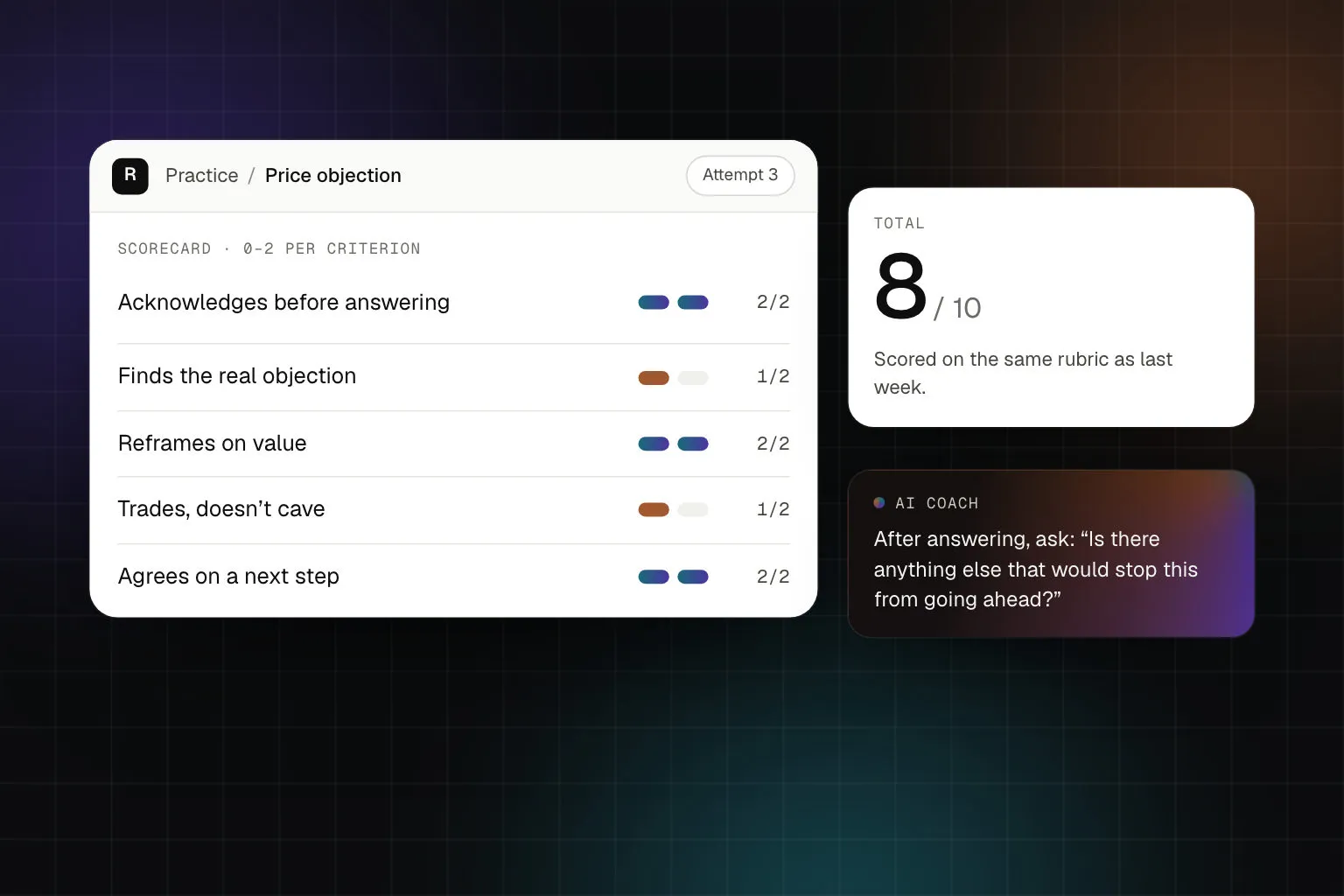
The objection reps lose without noticing is the one they think they’ve already won. The buyer says the price is too high, the rep explains the value well, the buyer nods and goes quiet, and the rep takes the silence as agreement. Two weeks later the deal is gone, because the real problem was a budget that had been cut, and nobody asked. The fix wasn’t a better rebuttal. It was one habit drilled until it was automatic: after answering, ask “Is there anything else that would stop this from going ahead?” Reps who practice that question a handful of times start hearing the real objection on the first call. Try it on your next price drill.
You can run all five drills with colleagues playing the buyer. If you want ready-made buyers with a brief and hidden objections, browse more sales scenarios to practice.
How to score objection handling
Score every attempt on the same five criteria, whatever the objection type. On The Reflection, the price objection buyer is Nia · AI head of field operations, and these are the criteria we use in a price objection drill with Nia, scored on five criteria, adapted so a trainer can apply them to any type. A simple scale works: 0 if it didn’t happen, 1 if it was partly there, 2 if it was clear.
| Criterion | Counts | Doesn’t count |
|---|---|---|
| Acknowledges before answering | Repeats the concern in the buyer’s words and asks a question about it. | Defends the price, the timing or the product in the first sentence. |
| Finds the real objection | Keeps asking until the real constraint is named: budget, a contract, the person who decides, a past failure. | Treats the first objection as the only one. |
| Reframes on value | Uses the buyer’s own goals, numbers or pilot results, and compares options like for like. | Lists features or repeats the pitch. |
| Trades, doesn’t cave | Any change to price, terms or scope comes with something in return: a longer term, a phased rollout, a reference call. | Offers a discount or a concession before the buyer asks for one. |
| Agrees on a next step | Ends with a dated step that includes the person who decides. | “I’ll send over a revised quote,” or “Let’s touch base next month.” |
Two rules make the rubric useful. First, the scorer writes down the line that earned or lost each point, so the feedback is about what the rep said, not the scorer’s impression. Second, the rubric doesn’t change between attempts, or between week one and week four. If your team sells with MEDDIC, SPIN or its own playbook, add or swap criteria once, then keep them fixed.
A weekly practice rhythm
The rhythm below rests on two lines of research. Deliberate practice, meaning effortful practice designed to improve a specific part of performance, with feedback, was linked to higher skill among student violinists1; a later replication found the effect was real but considerably smaller2. A review of spaced practice found that spreading practice over several sessions helped people remember more than cramming it into one, with the best gap growing as the time to the test grew3. Those studies looked at music and verbal recall tasks, not sales calls, so read them as a direction rather than a dose.
In practice that means short, scored sessions on a rep’s weakest objections, spread across the week, and a re-measure at the end with the same rubric.
| Week | What to practice | How many runs | Measure |
|---|---|---|---|
| 1 | All five types once, to get a baseline | One scored run per type | Baseline score per criterion; pick the two weakest types |
| 2 | The two weakest types | Three runs per type, on different days, 10 to 15 minutes a session | Score every run; read the lowest criterion before the next run |
| 3 | A third type, plus one run each of the week-two types | Three runs of the new type, one of each earlier type | Check the week-two types held after a few days off |
| 4 | All five types again, then a harder buyer on the weakest | One scored run per type | Re-measure against week one on the same rubric |
After week four, start the next cycle from the new weakest types. Once reps have the basics, you can turn practice into a team negotiation competition, and when a new hire finishes the cycle, use the scores to measure whether a rep is ready for the field.
Practicing with an AI buyer
The hard part of this rhythm is finding a colleague who will play the buyer three times a week and score consistently. An AI buyer removes that bottleneck: reps practice whenever they have ten minutes, and every run is scored the same way.
Here is what a session looks like on The Reflection. The rep picks a scenario and talks to an AI buyer by voice or video. In the price objection scenario, that buyer is Nia · AI head of field operations, who holds a cheaper competing quote and mentions her budget cut only when the rep asks the right question. She comes in three versions, from friendly to one where she brings in a procurement manager who pushes for a discount and longer payment terms, so the same objection can get harder as the rep improves.
After each run, the AI scores the transcript on the criteria, quotes the lines that earned or lost points and leaves comments tied to timestamps in the conversation. The scores come from what the rep says. The AI doesn’t read the rep’s emotions; only the AI buyer has a mood, as part of the scenario. Managers see each rep’s gaps by skill and deal stage, and can assign the next scenario from the gap.
Scenarios can be built around your product, your pricing and the buyers your reps actually meet, and scored against your own methodology. If you want to see how that works for your team, you can let reps practice with AI buyers and get scored after each session.
Questions sales managers ask
How long does objection handling training take?
Plan a four-week cycle: a baseline in week one, focused practice on the two weakest types in weeks two and three, and a re-measure in week four. Each session takes 10 to 15 minutes. After that, keep a lighter rhythm going and start a new cycle from the new weakest types.
How do you know the training worked?
Compare the week-four scores with the week-one baseline on the same rubric, criterion by criterion. A rep who stopped discounting before the buyer asked, or who now leaves calls with a dated next step, has changed behavior, not just learned a technique. Then check the same criteria on real calls: if recorded calls are scored on the same model as practice, you can see whether the change carried over to the field.
Sources
- K. Anders Ericsson, Ralf Th. Krampe and Clemens Tesch-Römer. The role of deliberate practice in the acquisition of expert performance. Psychological Review 100(3), 363–406, 1993.
- Brooke N. Macnamara and Megha Maitra. The role of deliberate practice in expert performance: revisiting Ericsson, Krampe & Tesch-Römer (1993). Royal Society Open Science 6, 190327, 2019.
- Nicholas J. Cepeda, Harold Pashler, Edward Vul, John T. Wixted and Doug Rohrer. Distributed practice in verbal recall tasks: a review and quantitative synthesis. Psychological Bulletin 132(3), 354–380, 2006.