
On this page
This performance review template is a form you can download and use in your next review cycle, with no sign-up and no email. It has a row for each goal and competency, a five-point rating scale with clear levels, and space for evidence and a next step. Below the form: what each section is for, how to rate, which questions to ask in the meeting, and how to adapt it for annual, mid-year, probation and quarterly reviews.
Free performance review template
The form has one row per goal or competency. The employee and the manager each rate the row from 1 to 5, and the manager adds the evidence, a comment and one next step. The rating scale is repeated at the bottom of the file. The file is a CSV: it opens in Excel and Google Sheets.
| Section | Rows | What goes in each row |
|---|---|---|
| Results | Goal 1, Goal 2, Goal 3 | The goal as agreed at the start of the period, both ratings, evidence, a comment and a next step |
| Competencies | Job knowledge, Quality of work, Communication, Collaboration, Dependability, Leading people (for people managers) | Both ratings, evidence, a comment and a next step |
| Summary | Overall rating, Strengths, Development areas | One overall rating; two or three strengths and development areas, each with an example |
| Next period | Goal 1, Goal 2, Goal 3, Support needed from manager | The goals for the next period and what the employee needs from you to reach them |
| Employee | Employee comments | The employee’s own words, added after the meeting |
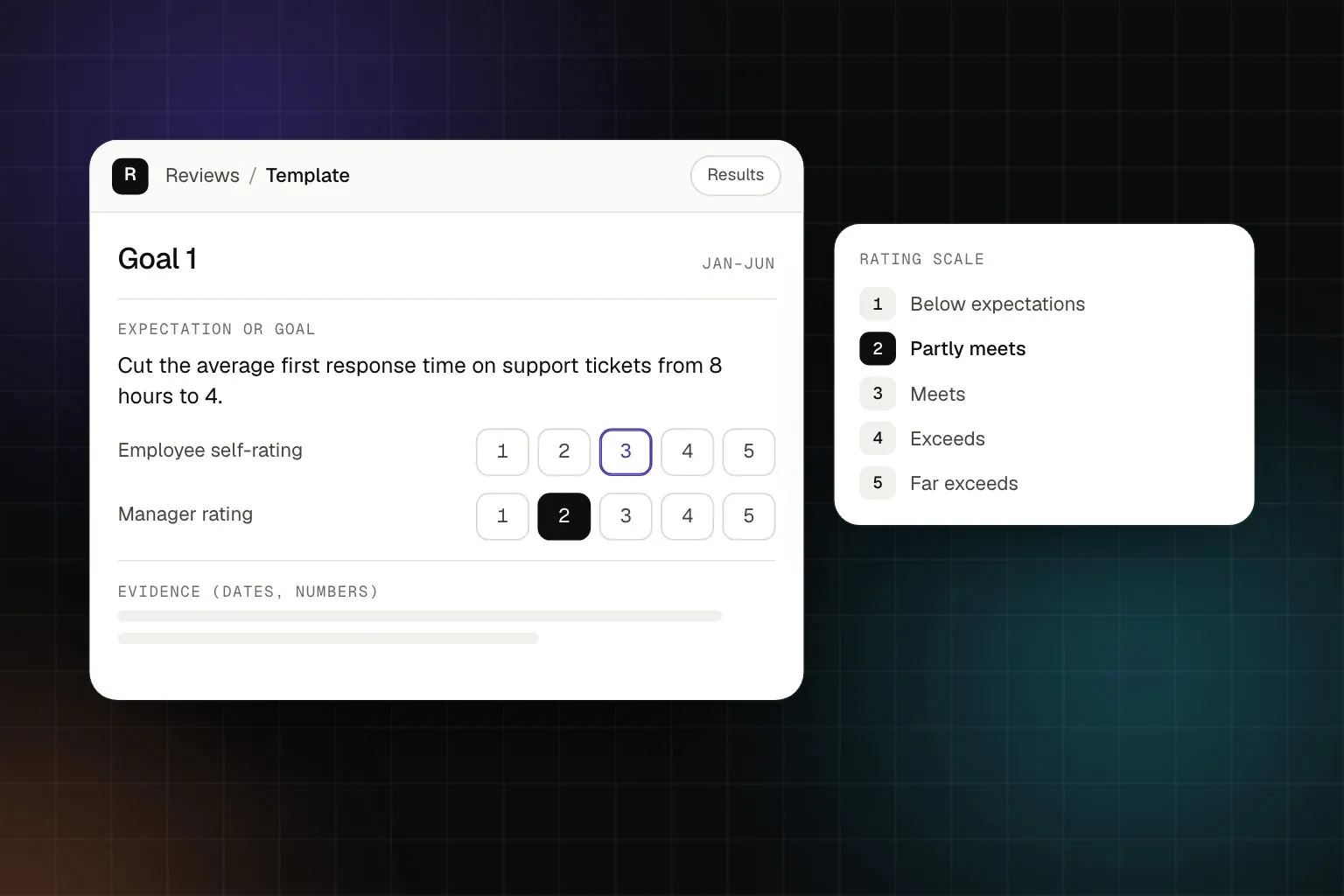
The first row of the file is filled in as an example. Here it is, column by column.
| Column | Example |
|---|---|
| Expectation or goal | Cut the average first response time on support tickets from 8 hours to 4 over January to June |
| Employee self-rating (1–5) | 3 |
| Manager rating (1–5) | 2 |
| Evidence (dates, numbers) | Helpdesk report: 5.1 hours on average for January to June; 3.8 hours in May and June, after the triage rota started on April 28 |
| Comment | Partly met: the January to June average was 5.1 hours against the agreed 4. The triage rota Elena set up is what changed it: May and June ran at 3.8 hours. |
| Next step | Write up the triage rota by July 31 so the two new agents can run it |
Two things make this row useful. The evidence has dates and numbers, so the rating rests on something other than memory. And the two ratings differ: Elena rates the result by where it ended and gives herself a 3; her manager rates the goal as it was agreed, an average over the whole period, and gives a 2, “partly meets expectations.” That gap is not a mistake in the form. It is the first thing to talk about in the meeting, where the manager can credit the turnaround in May and June and still rate the goal that was set. When you turn the rows into a written review, here is how to fill in the comments and back each rating with evidence.
What to include in a performance review form
MIT Human Resources suggests that a written review cover four things: performance compared with agreed expectations, key accomplishments and contributions, examples of strengths and development opportunities, and key expectations for the coming year1. Each of them has a place in the template.
- Performance against expectations goes into the Results rows, one per goal agreed at the start of the period, and into the Competencies rows. Copy the goals exactly as they were agreed, so the employee is rated against what you asked for, not what you remember.
- Accomplishments go into the Evidence column. Dates, numbers, names of projects. If there is nothing to write there, the rating is a guess.
- Strengths and development areas have their own rows in the Summary section. Two or three of each, every one with an example.
- Expectations for the next period are the Next period goals, together with the support the employee needs from you.
The template adds two columns to this list. The self-rating sits next to the manager rating, so differences are visible before the meeting. And every row ends with a next step: a review that changes nothing for the coming months was an evaluation, not a review.
Leave out what the form cannot hold fairly: labels about personality, events from outside the period and anything that belongs in a formal HR process. Who can see completed forms and how long they are kept is set by your company’s HR policy, so follow it.
A five-point rating scale with clear levels
A rating means something only if two managers would give the same number for the same work. Without written descriptions of the levels, each manager rates against a private standard: one manager’s 3 is another’s 4, and ratings across a team cannot be compared. The fix is to describe each level by what the person does, not by how good they are.
| Rating | Level | What it looks like |
|---|---|---|
| 1 | Below expectations | Misses most goals; routine work needs frequent correction or help. |
| 2 | Partly meets expectations | Meets some goals; needs guidance on work that should be routine for the role. |
| 3 | Meets expectations | Delivers the agreed goals and handles the role without day-to-day guidance. |
| 4 | Exceeds expectations | Delivers beyond the goals; colleagues come to them for help in this area. |
| 5 | Far exceeds expectations | Results well beyond the role; changes how the team works in this area. |
A 3 is a good rating: the person did the job that was agreed. Say so in the meeting, or employees will read it as average. For wording that fits each level, see these comments for each rating level, skill by skill.
For the competency rows, write one line per level for your own roles before the cycle starts. “Communication: 3” means little until it says something like “keeps the customer informed without being chased.” Share the descriptions with employees together with the self-assessment, so they rate themselves on the same scale you use. If several managers review the same team, ask them to rate two or three anonymized rows together first and compare their numbers.
Defined levels are useful beyond the review itself. With the same approach you can assess skills against the same behavior-based levels across a team and see which gaps are shared.
Performance review questions for managers to ask
There are two kinds of questions in a review. The form asks the first kind in its columns: what was expected, what happened, what the evidence is, what comes next. The second kind is for the meeting itself, where the goal is to hear the employee’s view before you give yours.
What are some good performance review questions?
Good questions are open, refer to a specific period or piece of work, and ask for an example. “How did the launch go?” gets a polite summary. “What went well in the March launch, and what would you change?” gets something you can work with. Avoid yes-or-no questions and leading ones, such as “You’d agree it was a tough quarter?”
What are some good questions to ask in a performance review meeting?
These 22 questions are grouped by the parts of the conversation. You will not ask all of them. Pick one or two from each group and leave time for the answers. Where they fit in the conversation is covered in the steps of the review meeting, from opening to summary.
Results
- Which goal from this period are you most satisfied with, and why?
- Which goal did not go as planned? What got in the way?
- What did you deliver that was not on the original list?
- How did your work affect the results of the team?
Strengths
- What part of your work do colleagues come to you for?
- When did you do your best work this period? What was different?
- Which of your skills do we not use enough?
Challenges
- What took more time or effort than it should have?
- Where did you need a decision or information and not get it in time?
- What would you do differently if you started the period again?
- Is anything in how the team works making your job harder?
Development
- Which skill would make the biggest difference to your work next period?
- What would you like to learn, and how do you learn best?
- Which project or responsibility would stretch you?
- Where do you see your role a year from now?
Support from the manager
- What should I keep doing as your manager?
- What should I do differently?
- What do you need from me to reach your next goals?
Goals
- What should be your top priority for the next period?
- How will we both know you have reached it?
- What could get in the way, and what is the plan if it does?
- When should we check progress?
What are some good questions to ask on a performance appraisal?
On the written appraisal, keep the questions the same for every row, so the form reads the same way for every employee: What was expected? What happened, with dates and numbers? Which level on the scale fits, and why? What is one next step? For the Summary rows, ask: What should this person keep doing? What one thing would make the biggest difference if it changed?
What to send the employee before the meeting
Send the form a few working days before the meeting, with the self-rating column to fill in and the level descriptions attached. Add four or five questions:
- What were your main results this period? Add dates and numbers where you can.
- Which goal was hardest, and what got in the way?
- What are you most proud of from this period?
- What would you like to develop next period?
- What do you need from your manager to do your best work?
Read the answers before you fill in your own ratings, and note where your view differs. Those rows are where the meeting will spend most of its time. If colleagues see work you don’t, for example in cross-team projects, gather 360 feedback from peers before the review.
Writing goals for the next period
The SMART acronym comes from an article by George T. Doran in Management Review in 19812. In the original, a well-written objective is:
- Specific: it targets a particular area to improve.
- Measurable: it has a number, or at least an indicator of progress.
- Assignable: it is clear who is responsible for it.
- Realistic: it can be reached with the resources available.
- Time-related: it says when the result is due.
Later versions often swap Assignable and Realistic for Achievable and Relevant. Assignable is the letter worth keeping for a review: a goal that belongs to “the team” belongs to no one. Doran also noted that not every objective can be quantified. For those, agree on what you will look at to judge progress.
Three goals per period is enough, which is why the form has three rows. Put the date into the goal itself, and use the Support needed from manager row for what you commit to in return.
Can you give me an example of an employee performance goal?
Four examples for different roles:
- Sales representative: Close 10 new accounts in the mid-market segment by December 31, with at least three outside the current region.
- Customer support agent: Write five knowledge-base articles for the most frequent ticket types by September 30, and walk the next new hire through them.
- Software engineer: Join the on-call rotation for the billing service by October 15, with a runbook reviewed by the team lead.
- Team lead: Hold a monthly one-to-one with each person on the team from July to December, and agree on one development goal with each by August 15.
Each one names the result, the owner and the date. The numbers are yours to set: they should come from the role and last period’s results, not from a template.
Adapting the template: annual, mid-year, probation, quarterly
The full form is built for an annual review. For other types of review, remove what you won’t use and add what the conversation needs.
| Review | Remove | Add |
|---|---|---|
| Annual | Nothing: this is the full form | Last period’s goals copied into Results exactly as they were agreed |
| Mid-year | Overall rating and competency ratings, unless your company rates twice a year | A status for each goal (on track, at risk, off track) and a row for goals that have changed |
| Probation | Leading people, unless the person was hired to manage; annual goals | The objectives agreed at hiring as the Results rows, and a decision row: confirm, extend or end, following your company’s HR policy |
| Quarterly | Competencies, Overall rating, Strengths and Development areas | Priorities for the next quarter and one question: what is blocking you? |
Whatever you remove, keep the Evidence and Next step columns. They are what makes the form a working document rather than a score sheet.
The first form we used had a long list of competencies, a comment box for each and ratings with no definitions. Filling it in for a whole team took evenings, and most boxes ended up with the same polite sentence. We cut it down to the goals, a handful of competencies and a next step for every row, and wrote one line for each rating level. The forms got shorter and the meetings got better, because every row now had evidence to talk about. If your form takes longer to fill in than the meeting takes to hold, start cutting.
Use the same form to practice the conversation
A form helps you write the review. It does not prepare you for the meeting: the moment the employee disagrees with a 3, asks why the overall rating is not higher, or goes quiet.
On The Reflection, the same form and rating scale can be uploaded as the scoring criteria for a review scenario. A manager meets an AI employee, for example Nia · AI account lead, by voice or video and runs the review from the opening to the agreed goals. A run takes 5 to 20 minutes and ends with a score for each review skill and timestamped comments. The AI plays the employee and scores the manager’s conversation. It does not rate your real employees, and the form here is the standard for the conversation, not an assessment of anyone.
Annual reviews, mid-year check-ins, quarterly conversations and end-of-probation reviews can be set up as separate scenarios, each with its own criteria, the same way you adapt the template. Before the next cycle, your managers can rehearse reviews scored against your own review form.
Template questions
Word, Excel or PDF?
The template is a CSV file. It opens in Excel and Google Sheets, and from there you can save it as a workbook, paste the table into Word or export a PDF to print. CSV keeps no formatting, so set column widths and text wrapping once and save your own copy as the master.
How long should a review form be?
Short enough that you can fill it in properly for every person on your team. This template has 17 rows: three goals, six competencies, a summary, the next period and the employee’s comments. If a row stays empty for most of your employees, remove it.
Should a template include ratings?
If your company uses ratings for pay or promotion decisions, keep them, and define every level as in the scale above. If it does not, a review can work without ratings: the evidence, the comment and the next step carry it. Quarterly check-ins are often better without them. What does not work is a rating with no definition.
Sources
- MIT Human Resources. Performance Reviews.
- George T. Doran. “There’s a S.M.A.R.T. way to write management’s goals and objectives.” Management Review 70(11), November 1981, pp. 35–36.