
On this page
- Collect evidence from the whole period before you write.
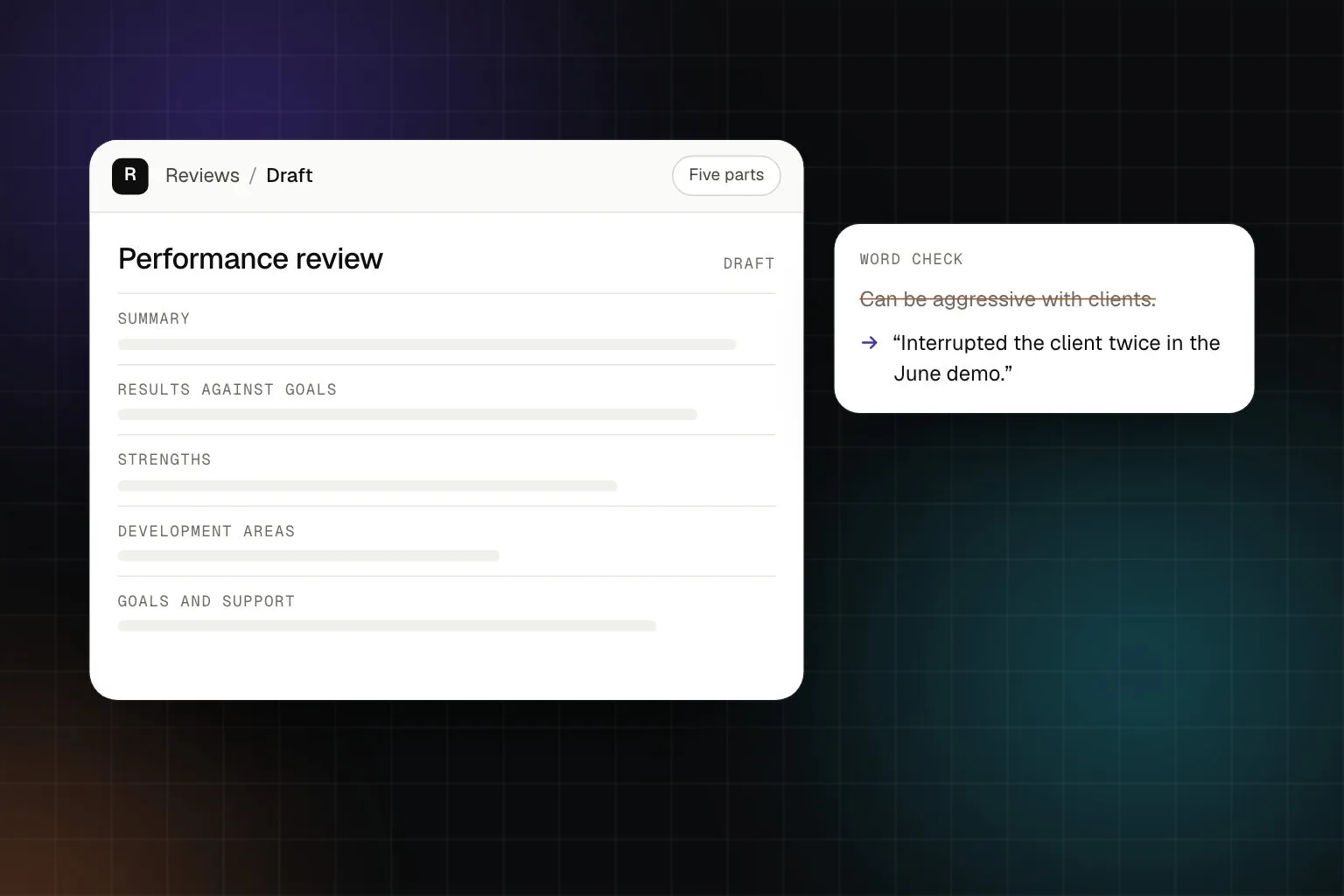
- Write five parts: summary, results against goals, strengths, development areas, goals and support.
- Base the rating on facts and give one line of reasoning for it.
- Before you send it, check every word that describes the person rather than the work.
Most managers learn how to write a performance review with a blank form, a deadline and a hazy memory of the last few weeks. Here is an order of work, a structure for the document, three full samples and a check for wording that drifts from the work to the person.
Before you write: gather evidence
A review covers the whole period, not the last month. Memory won’t do that on its own: recent events crowd out earlier ones, which reviewers call recency bias. Collect the record first. MIT’s HR guide starts the same way, with last year’s review, mid-year check-ins, the job description, the employee’s self-assessment and notes from the year1.
- Goals and expectations agreed at the start of the period, and any changes since.
- Results. Numbers, projects delivered, deadlines met or missed, with dates.
- Your 1:1 notes and earlier check-ins.
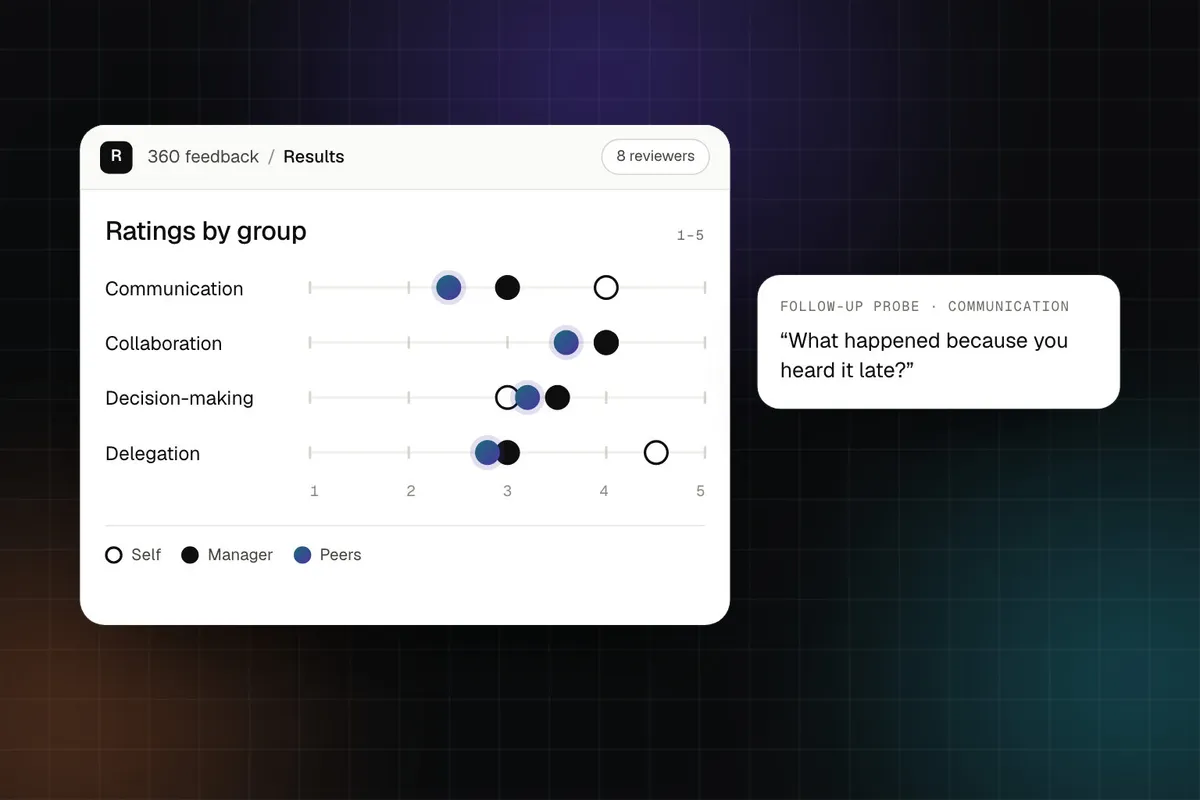
- Feedback from others. Colleagues, customers and direct reports see work you don’t. 360 feedback collected before you write gives you that view in one place.
- The employee’s self-assessment, if your process asks for one.
Write each item as a fact with a date: “Closed the Q3 migration two weeks early,” not “great work on the migration.” These notes feed every part of the document.
We don’t start with the form. A week or so ahead we ask the employee for a self-assessment, then go through our notes from the whole year and list facts with dates before we think about a rating. That part takes the longest, and it is where most of the review gets decided. Then we write the results, strengths and development areas, and the summary last. A few days before the meeting we send the agenda; the document itself we bring to the meeting, so the rating is never read without a conversation. Writing is half the job. The other half is saying it out loud, and that half only improves with practice.
A five-part structure for the review document
MIT’s HR guide asks reviewers to describe four things: performance compared to agreed expectations, key accomplishments and contributions, examples of strengths and development opportunities, and key expectations for the coming year1. We add a short summary at the top: it is what the employee reads first.
| Part | What it answers | How much |
|---|---|---|
| Summary | How did the period go overall, and what is the rating? | Two or three sentences |
| Results against goals | What was agreed, and what happened? | One line per goal |
| Strengths | What should they keep doing, and where did it show? | Two or three, each with an example |
| Development areas | Which one or two changes would make the biggest difference? | One or two, each with an example |
| Goals and support | What happens next period, and what will you do to help? | Two to four goals with a measure and a date |
If your company has a form, map these parts onto its fields; if not, start from our performance review form to download and adapt. Keep results before strengths and development areas, so every judgment rests on something already on the page.
How to write a performance review, part by part
What goes into each part, with a short example. For longer lists, see our performance review phrases by skill and rating level.
Summary
Write it last. Give the overall picture, the rating and the one thing that matters most for the next period.
Example: “A solid year. Kofi met four of five goals and became the person the team goes to for pricing questions. Rating: meets expectations. The focus for next year is forecast accuracy.”
Results against goals
Go goal by goal: what was agreed, what happened and, where it helps, why.
Example: “Goal: average first response under four hours. Result: 3.2 hours from July, after Hannah rebuilt the triage rota; the first half averaged 5.1.”
Strengths
Name the strength, then show where it appeared and what it changed.
Example: “Hannah’s handovers are the clearest on the team. During the November escalation, the night shift closed the case from her notes without calling her.”
Development areas
Pick one or two. Describe the behavior and its effect, then say what good looks like.
“Needs to be more proactive.”
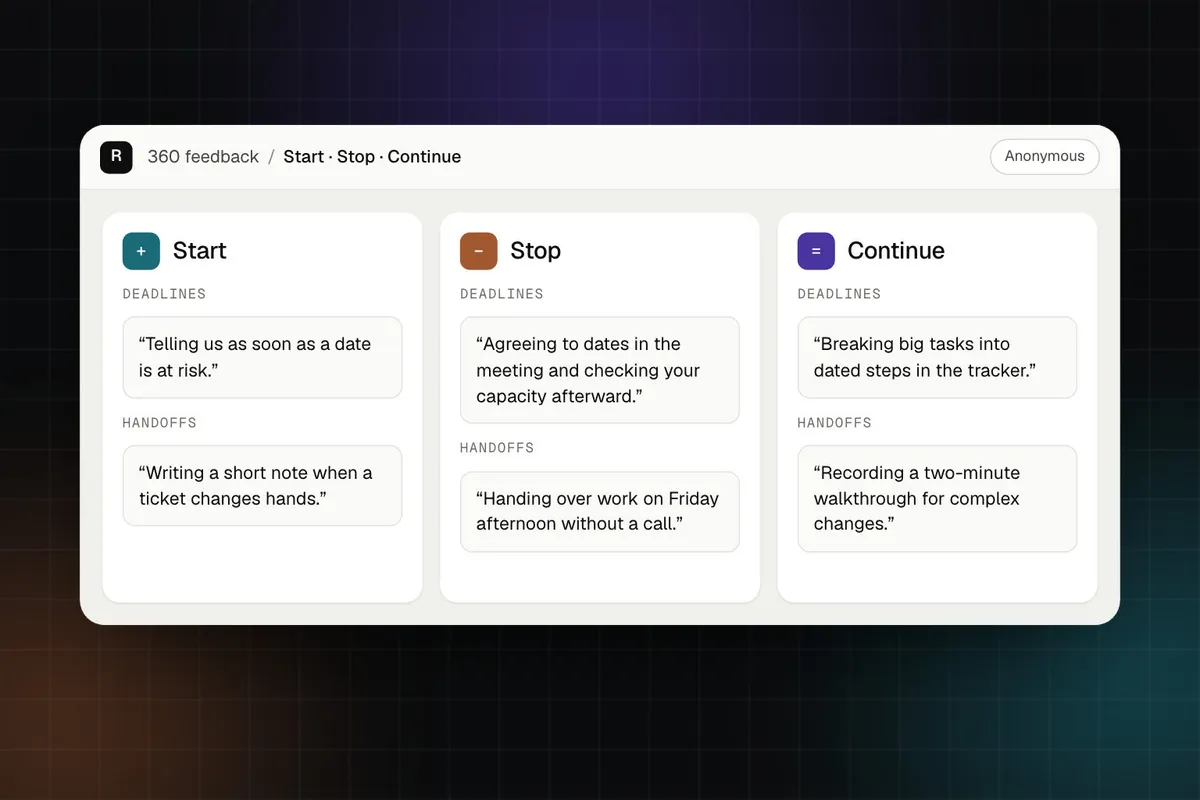
“Twice this year, delays on the vendor project came to light on the deadline. Next period, flag any risk to a date as soon as you see it.”
Goals and support
Each goal gets a measure and a date, plus what you will do to help.
Example: “By June, run the weekly client report without review from me. For the first two cycles, I’ll pair you with Ruth, who built the current version.”
Justify the rating with evidence
The rating is where the rater’s own habits show. Scullen, Mount and Goff studied developmental ratings of two large groups of managers, 2,350 and 2,142 people, each rated by two bosses, two peers, two direct reports and themselves. The raters’ own rating tendencies explained 62% and 53% of the variance in the ratings. The managers’ actual performance explained 21% and 25%2. In those data, a rating said more about who gave it than about who received it.
You cannot remove that effect, but you can make your rating easier to check:
- Decide the rating after you write the results, not before.
- Write one line of reasoning that links the rating to evidence: “Meets expectations: four of five goals met; the missed one depended on a vendor release that slipped.”
- Check it against your scale. If “exceeds” means “consistently beyond the role,” point to where that happened. No definitions yet? Borrow our five-point rating scale with defined levels.
- Check the period. If every reason comes from the last two months, go back to your notes.
Three performance review samples
Each sample follows the five parts, shortened. They are illustrative: the people and numbers are made up. Under each, three notes on what makes it work.
Sample 1: exceeds expectations
Summary. Hannah had an outstanding year. She beat both service goals, rebuilt how her team handles escalations and trained two new leads. Rating: exceeds expectations, because the escalation process she designed went beyond her role and is now used across the department.
Results against goals. First response: goal under 4 hours, result 3.2 hours from July (5.1 in the first half). Customer satisfaction: goal 85%, result 89% for the year. Onboarding: goal two new leads trained; both now run shifts on their own.
Strengths. Clear handovers: in the November escalation, the night shift closed the case from her notes. She spots process problems early and brings a fix, not just the problem.
Development area. She takes on fixes herself instead of delegating. In Q3 she spent three weekends on the triage rota while two leads had capacity.
Goals and support. Hand one improvement project to a lead and coach them through it by June. I’ll join the planning sessions for the first month.
- The rating line names what lifts it above “meets”: work used beyond her team.
- Every result has a goal, a number and a period.
- Even a top performer gets a development area, tied to a specific quarter.
Sample 2: meets expectations
Summary. Kofi had a solid year. He met four of five goals and became the person the team goes to for pricing questions. Rating: meets expectations. The missed goal depended on a vendor release that slipped to January.
Results against goals. Renewals: goal 90%, result 92%. New accounts: goal 6, result 6. Pricing guide for the team: delivered in May. Quarterly reviews with all 12 key accounts: done. CRM migration of his accounts: 70% done, waiting for the vendor release.
Strengths. Customers trust him: three key accounts asked for him by name at renewal. His pricing guide cut the questions the team sends to finance.
Development area. Forecasting. His Q3 forecast was off by 18% because two deals moved and the pipeline was not updated until month end.
Goals and support. Forecast within 10% each quarter, with a weekly pipeline update. I’ll review the pipeline with him every Monday in Q1.
- “Meets expectations” reads as a good result, with the reason in one line.
- The missed goal is explained with a fact, without excuses or blame.
- The development area is narrow and has a measurable goal attached.
Sample 3: below expectations
Summary. Elena did not meet the expectations of her role this year. Three of five project milestones were late, and stakeholders often learned about delays on the deadline. Rating: below expectations. The plan below sets out what needs to change by the mid-year review.
Results against goals. Milestones: 2 of 5 on time; the goal was all five within the agreed slack. Weekly status reports: sent every week until April, then irregularly. Budget: within 3% of plan, goal met.
Strengths. Careful with budgets and vendor contracts: finance raised no issues on any of her projects.
Development area. Raising risks early. On the office move and the system upgrade, delays were known a week or more before the deadline but first reported on the day.
Goals and support. A status report every Friday; any risk to a date raised within two working days. We’ll meet every two weeks until the mid-year review, and I’ll ask Victor to walk her through his risk log.
- The rating is stated plainly in the first lines. Elena does not have to hunt for it.
- The criticism is about two projects and one behavior, not about her as a person.
- The plan has a measure, a date and support, so the next review can check it.
Words to check before you send
Feedback about the person instead of the work is hard to act on, and it is not spread evenly. Kieran Snyder collected 248 performance reviews from 180 people in tech who agreed to share them. Among reviews with critical feedback, criticism of personality (“watch your tone,” “stop being so judgmental”) appeared in 71 of 94 reviews received by women and in 2 of 83 received by men3. It is a small, voluntary sample, not a representative study.
Textio, a company that sells software for checking the wording of feedback, analyzed written performance feedback received by more than 25,000 people. Women got 22% more feedback about their personality than men, positive and negative combined4. In a separate internet survey of 500 people in the same report, women were 7 times more likely than men to say they had been described as “opinionated” and 11 times more likely to say “abrasive.” These are what people recall hearing, not counts from documents.
Before you send a review, search it for words that describe the person and replace each with what they did.
| Word | Ask yourself | Write instead, for example |
|---|---|---|
| abrasive, aggressive | What did they say or do, and what was the effect? | “Interrupted the client twice in the June demo.” |
| opinionated | Was the problem the view or how it was raised? | “Reopened the vendor choice after the team agreed.” |
| emotional | What happened, and in which meeting? | “Raised her voice in the March planning review.” |
| difficult | Which behavior, in which situation? | “Declined three requests from sales without suggesting an alternative.” |
| lazy, unmotivated | What was not done, and by when? | “Missed four of six report deadlines in Q2.” |
| not a team player | Which team task, and what was the effect? | “Did not hand over open tickets before leave; two customers waited a week.” |
| nice, helpful | Helpful how, and with what result? | “Trained two new hires on the billing system; both now work on their own.” |
After the meeting: the final write-up
The meeting often changes the review: the employee adds context, or you agree on different goals. Update the document so it records what was actually agreed. MIT’s HR guide lists the same steps after the conversation: record notes from the meeting and plan follow-up on open issues and goals1. For the meeting itself, see how to conduct the review meeting step by step.
What comments to write after a performance review?
Add a closing note of three or four sentences: what you discussed, what changed in the document, the goals you agreed on and the date of the next check-in. If your form has a field for the employee’s comments, ask them to fill it in. Their view belongs in the record even when you disagree with it. Follow your company’s HR policy on who signs and when.
We discussed the year and the rating on January 14. Kofi pointed out that the two Q3 deals moved because of the customer’s budget freeze; I have added that to the results. We agreed on two goals: forecasts within 10% each quarter and a weekly pipeline update. Next check-in: April 15.
Using AI to draft a performance review
An AI tool can turn your notes into a first draft quickly. The review is still yours, so check four things before you use it:
- Facts. Every result, date and example comes from your notes for this period. Delete anything the tool filled in on its own.
- The rating matches the evidence. If the text says “exceeds” and the results say “meets,” one of them is wrong.
- No judgments about personality. Run the word check above. Generated text is not exempt.
- It sounds like you. If you would not say a sentence to this person’s face, rewrite it. Before you paste in notes, check your company’s policy on putting employee information into AI tools.
The Reflection does not write reviews. It helps with the other half: rehearsing the conversation in which the review is discussed.
Practice delivering what you wrote
A review that reads well can still go wrong in the room. “Your communication needs work” looks fine on paper; said to someone who disagrees, it invites “What does that mean?” You need the example ready.
You can practice the review conversation with an AI employee before the real one. In one scenario, Omar · AI warehouse supervisor asks exactly that question, then disputes an example from March. A run takes 5 to 20 minutes and ends with a score for each review skill, such as using specific examples and separating facts from opinion, plus timestamped comments. Another one is open to read in full: a review for an account lead whose year went off track after an acquisition, with Nia · AI account lead.
If your managers are facing their first review cycle, start with new manager training for a first review cycle. It covers the talks new managers face first, including first feedback and a missed target.
Questions about writing reviews
How long should a performance review be?
Long enough to cover every goal with evidence, short enough for the employee to read before the meeting. A line per goal and a few sentences per part is usually enough.
Should the employee see it before the meeting?
It depends on your process, so follow your company’s HR policy. Sharing it shortly before the meeting gives the employee time to read it and come with questions. Some managers prefer to share it in the meeting, so the rating is never read without a conversation. Either way, the review should not be the first time they hear about a problem.
Sources
- MIT Human Resources. Performance Reviews.
- S. E. Scullen, M. K. Mount and M. Goff. Understanding the latent structure of job performance ratings. Journal of Applied Psychology, 85(6), 956–970, 2000.
- Kieran Snyder. The abrasiveness trap: High-achieving men and women are described differently in reviews. Fortune, August 26, 2014.
- Textio. Language Bias in Performance Feedback. 2022.