
On this page
- A good comment names a situation, the behavior you saw, its impact and what comes next.
- Match the phrase to the rating. “Exceeds” needs evidence beyond the role; “needs improvement” needs a clear next step.
- Write about the work, not the person. “Missed two handoffs” helps; “unreliable” does not.
- Read each comment out loud before the meeting. If it sounds harsh or empty spoken, rewrite it.
These performance review examples are written for managers who have a review form open and cannot find the words. Every phrase is from the manager about the employee, grouped by skill and by rating level, so you can pick one, swap in your own facts and paste it in. Treat them as a starting point: a phrase with no example from the past year behind it is still a vague comment.
A simple formula for any review comment
Weak review comments usually miss when it happened, what the person did and why it mattered. The Situation–Behavior–Impact model from the Center for Creative Leadership covers all three. You clarify the situation, describe the specific behavior you observed, and explain its impact. CCL’s research found that SBI reduces anxiety around giving feedback, as well as the defensiveness of the person hearing it1.
In a review, add a fourth part: the next step. Without it, the employee has to guess what you want.
| Part | What it answers | Example |
|---|---|---|
| Situation | When and where? | “During the Q3 migration to the new billing system…” |
| Behavior | What did they do that anyone could have seen? | “…Jordan wrote the test plan and ran the overnight checks himself…” |
| Impact | What changed because of it? | “…so we went live on schedule with no billing errors in the first month.” |
| Next step | What do you want next year? | “Next year I’d like him to coach two junior analysts on the same approach.” |
Put together, that is one comment of two or three sentences. Use the phrases below the same way: keep the phrase, add your own situation and impact.
Overall comments by rating level
Most review forms end with an overall rating and a summary box. The examples use three common levels: exceeds expectations, meets expectations and needs improvement. On a five-point scale, the in-between levels fall between these.
What are good overall comments for a performance review?
A good overall comment matches the rating, names what drove it and points to next year.
Exceeds expectations
- “Nadia consistently delivered beyond the scope of her role this year. Her redesign of the onboarding process cut the time new hires need to get set up, and other teams have since adopted it.”
- “Felix set the standard for quality on the team. His code reviews caught issues before release, and two junior developers improved noticeably under his guidance.”
- “Malik did not just hit his targets; he changed how the team plans its work. The weekly planning format he introduced is now used across the department.”
Meets expectations
- “Theo delivered what we agreed on at the start of the year, on time and to a good standard. Next year I’d like to see him take the lead on at least one project.”
- “Hana is a reliable member of the team. Her reports are accurate and on schedule, and colleagues know they can count on her.”
- “Ines met all her goals this year and handled a heavier workload in Q4 without a drop in quality. Her next step is to share more of her ideas in team meetings.”
Needs improvement
- “Ravi met some of his goals this year, but three of five project deadlines slipped by more than a week. Our focus for the next quarter is planning and flagging risks early.”
- “Carmen’s client work is strong, but internal reporting was often late or incomplete, which held up the monthly forecast. We have agreed on a weekly checkpoint to fix this.”
- “Tobias has the technical skills for the role, but the handoffs to the support team often lacked the detail they needed. We will review his handoff notes together each sprint until this improves.”
A “needs improvement” comment should never be the first time the employee hears about a problem.
Performance review phrases by skill
The eleven skills below appear on most review forms under these or similar names. For each, there is a strength and an area to improve at three rating levels: even a top performer has a next step. Replace the bracketed parts with your own facts. If you don’t have a form yet, our downloadable review form with competency rows covers several of these skills, each rated on a defined five-point scale.
Communication
| Rating | Strength | Area to improve |
|---|---|---|
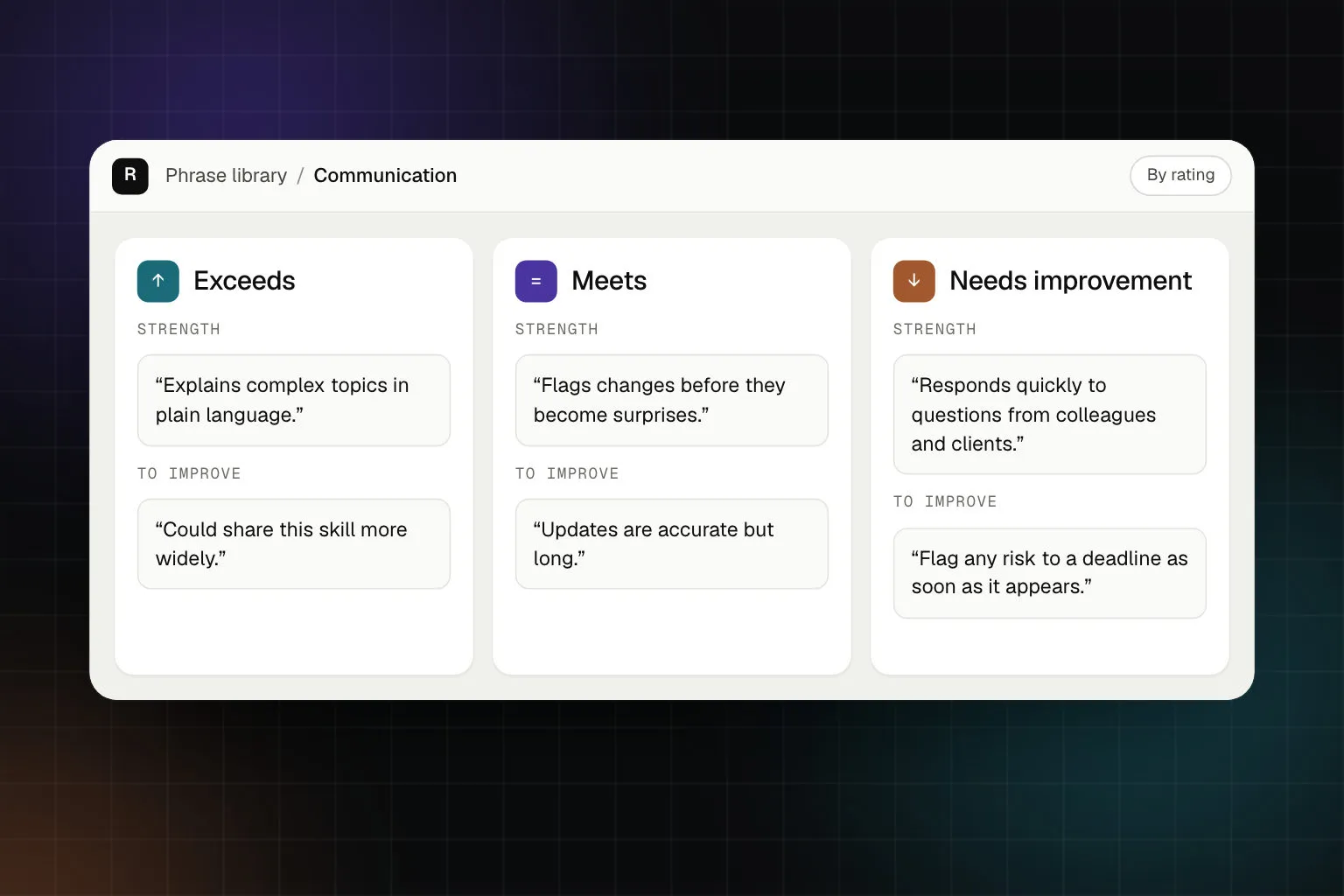
| Exceeds | “Explains complex topics in plain language. After [her briefing on the pricing change], the sales team had no follow-up questions.” | “Could share this skill more widely, for example by running [the monthly product update] for the wider team.” |
| Meets | “Keeps stakeholders informed about progress and flags changes before they become surprises.” | “Updates are accurate but long. Leading with the decision needed would help busy readers act faster.” |
| Needs improvement | “Responds quickly to questions from colleagues and clients.” | “Did not tell the team about [the delayed delivery] until the day it was due. Next quarter, flag any risk to a deadline as soon as it appears.” |
What are some effective phrases to describe cooperation and teamwork in a performance review?
Effective teamwork phrases describe what the person did for others: who they helped, what they shared, how they handled disagreement. “Great team player” says none of that.
| Rating | Strength | Area to improve |
|---|---|---|
| Exceeds | “Volunteered to cover [two accounts] when a colleague was on leave, and handed them back with clear notes.” | “Takes on so much for others that her own priorities sometimes slip. It’s fine to say no and point people to the right owner.” |
| Meets | “Works well with other teams and shares information without being asked.” | “In planning meetings, tends to agree and then raise concerns later. Raising them in the room would save the team rework.” |
| Needs improvement | “Delivers his own part of shared projects reliably.” | “Disagreements with [the design team] became personal in two meetings this year. We will work on keeping the discussion on the options, not the people.” |
Quality of work
| Rating | Strength | Area to improve |
|---|---|---|
| Exceeds | “Her work rarely needs a second review. [None of the twelve releases] she owned this year needed a fix after launch.” | “Could help raise the team’s standard by writing up the checklist she uses.” |
| Meets | “Produces accurate, well-organized work that meets the team’s standards.” | “Small errors in [client-facing documents] still reach the final version. A last read-through before sending would catch most of them.” |
| Needs improvement | “Understands what good work looks like and can produce it when there is time.” | “[Four of ten reports] this quarter needed corrections after they went out. We’ll agree on a review step before anything is sent.” |
Productivity and quantity of work
| Rating | Strength | Area to improve |
|---|---|---|
| Exceeds | “Handled [the highest ticket volume on the team] while keeping quality high.” | “The pace is not sustainable without help. Next year, let’s automate [the weekly export] instead of doing it by hand.” |
| Meets | “Completes the expected volume of work consistently, month after month.” | “Output drops when priorities change midweek. Re-planning the week out loud with me would help.” |
| Needs improvement | “Puts real care into each piece of work.” | “Closed [about half] the cases the role expects each week. We’ll look at where the time goes and set a target for the next 60 days.” |
What are some effective phrases to describe dependability in a performance review?
Dependability phrases work best when they point to a pattern: deadlines kept over a year, commitments followed through, someone the team turned to when it mattered.
| Rating | Strength | Area to improve |
|---|---|---|
| Exceeds | “The person the team turns to when something has to work. During [the year-end close] he owned every critical step and delivered each one on time.” | “Too much depends on him alone. Next year, let’s document [the close process] so others can step in.” |
| Meets | “Does what she says she will do. Commitments made in meetings are followed through without reminders.” | “When a deadline is at risk, tell me early, even if the answer is not ready yet.” |
| Needs improvement | “Delivers well when the task is clearly defined.” | “Missed [three agreed deadlines] without warning this year. From now on, any slip gets flagged at least two days ahead.” |
Time management
| Rating | Strength | Area to improve |
|---|---|---|
| Exceeds | “Balanced [three parallel projects] this year and delivered all of them on schedule.” | “Could share how she plans her week with newer team members.” |
| Meets | “Prioritizes well and meets deadlines on regular work.” | “Larger tasks tend to start late. Breaking them into weekly milestones would spread the load.” |
| Needs improvement | “Works hard when a deadline is close.” | “Urgent requests regularly push planned work past its deadline. We’ll agree on which requests can wait and review the plan every Monday.” |
Problem-solving
| Rating | Strength | Area to improve |
|---|---|---|
| Exceeds | “Found the root cause of [the recurring invoice errors] that had been patched for months, and fixed it for good.” | “Could involve the team earlier, so they learn how he gets to the root cause.” |
| Meets | “Resolves day-to-day issues independently and knows when to escalate.” | “Tends to fix the symptom and move on. Next time, take ten minutes to ask why it happened.” |
| Needs improvement | “Raises problems quickly when they appear.” | “Often brings problems without a proposed solution. Coming with one option, even a rough one, is the next step.” |
Initiative
| Rating | Strength | Area to improve |
|---|---|---|
| Exceeds | “Noticed [customers dropping off at the same step] and proposed a fix before anyone asked. It is now part of the product.” | “Has more ideas than time. Let’s pick the one or two with the biggest impact for next year.” |
| Meets | “Takes ownership of his work and suggests improvements when he sees them.” | “Waits for direction on tasks he could start himself. I’d like him to propose a plan first and check it with me.” |
| Needs improvement | “Follows instructions carefully and completely.” | “Rarely takes on work beyond the assigned tasks. For the next review, I’d like to see one improvement she proposed and led.” |
Adaptability
| Rating | Strength | Area to improve |
|---|---|---|
| Exceeds | “When [the reorganization] changed her team mid-year, she learned the new process fast and helped others through it.” | “Could help the team see why a change is happening, not just how to follow it.” |
| Meets | “Adjusts to changing priorities without losing quality.” | “Takes a while to commit to new tools. Trying them early would give him more say in how they’re set up.” |
| Needs improvement | “Is thorough with established processes.” | “Kept using [the old reporting template] for two months after the switch. We’ll set a date to move fully to the new one.” |
Customer focus
| Rating | Strength | Area to improve |
|---|---|---|
| Exceeds | “Customers ask for her by name. She turned [a complaint from a key account] into a renewal.” | “Could turn what she hears from customers into input for the product team.” |
| Meets | “Handles customer requests politely and resolves them within the agreed time.” | “Answers the question asked but sometimes misses the real problem behind it. One follow-up question would help.” |
| Needs improvement | “Knows the product well and can answer most questions.” | “[Two customers] escalated after replies that read as dismissive. We’ll review a few replies together each week until this improves.” |
Leadership
| Rating | Strength | Area to improve |
|---|---|---|
| Exceeds | “Built a team that runs well without him in the room. [Two of his reports] were promoted this year.” | “Ready to lead across teams. Next year, let’s find a cross-functional project for him to own.” |
| Meets | “Sets clear goals for the team and holds regular one-on-ones.” | “Gives praise readily but avoids critical feedback. Raising issues earlier would help the team improve faster.” |
| Needs improvement | “Is approachable, and the team feels comfortable bringing her problems.” | “Decisions often wait for her, which slowed [the launch] by two weeks. We’ll agree on which decisions the team can make without her.” |
Appraiser comments: summing up the review
The appraiser comment is the manager’s summary at the end of the form, and the part people reread months later. It should stand on its own: the rating, the reason and next year’s focus.
What are some good comments to include in an employee appraisal?
One sentence on the result, one on what drove it, one on what comes next.
| Rating | Appraiser comment |
|---|---|
| Exceeds | “Nadia exceeded expectations this year. Her new onboarding process is now used across three departments, and she trained the people who run it. Next year she will lead the hiring plan for the team.” |
| Meets | “Hana met expectations across all her goals. Her reports were accurate and on time every month. Next year’s focus is speaking up in planning meetings, where her knowledge of the data is often missing.” |
| Needs improvement | “Ravi’s results this year were below expectations, mainly because of missed project deadlines. His client relationships remain a strength. We have agreed on a 90-day plan with weekly check-ins on planning and early risk flags.” |
Keep it to facts the employee already heard during the year, and follow your company’s HR policy on what the form must include. To see where the appraiser comment sits in the full document, read how to structure the whole review, from evidence to summary.
From vague to specific
Most first drafts are vague. To fix one, ask the formula’s questions: when, what exactly, and what changed because of it.
| Vague | Specific |
|---|---|
| “Great job this year.” | “You closed the regional retail account a month ahead of plan, and your proposal is now our template for similar clients.” |
| “Needs to communicate better.” | “Twice this quarter the team learned about a delay on the due date. I need to hear about risks as soon as you see them.” |
| “Is a team player.” | “You covered Malik’s accounts during his leave and handed them back with notes he could act on the same day.” |
| “Lacks attention to detail.” | “Three of the last five client decks went out with wrong figures. Let’s add a second check before anything is sent.” |
| “Shows initiative.” | “You noticed the drop in renewals in March and proposed the reminder emails before anyone asked. Renewals recovered the next quarter.” |
| “Has a bad attitude.” | “In the last two planning meetings you dismissed proposals before they were finished. I’d like you to ask one question before you object.” |
| “Should be more proactive.” | “You waited for my approval on tasks you could decide yourself, like vendor quotes under the budget limit. Go ahead and tell me afterward.” |
| “Good leadership skills.” | “Your team hit its targets while you were out for a month, because you had agreed in advance on who decides what.” |
The specific versions leave out words about character, like “attitude” or “negative,” and describe behavior the employee can recognize and change. If you cannot find an example for a comment, leave it out.
Positive review examples
“Great job” feels warm but tells the employee nothing about what to repeat. The examples below name what the person did and why it mattered.
Can you give me an example of a positive review I can write for an employee?
Here is a short positive review that follows the formula from start to finish:
“Jordan had a strong year. When our largest client threatened to leave in May, he set up weekly calls with their operations lead and fixed the three reporting issues they raised. They renewed for two years in September. His calm handling of the escalation is something I’d like the rest of the team to learn from, and next year I’d like him to run our client review process.”
Can you give me some examples of positive employee comments?
- “Your handover notes before your vacation were so clear that nobody had to call you. That is rarer than you think.”
- “The way you ran the retrospective after the outage kept it about the process, not about who was to blame. The team spoke up more than usual.”
- “You took the time to show Ines how the forecast model works. She now runs it on her own.”
What are some good comments I can say to my staff?
The same, only shorter. Say it soon after the moment and name the behavior.
- “The way you answered the client’s pricing question today was exactly right. Clear, and you didn’t give anything away.”
- “I noticed you stayed with the new hire until her setup worked. That’s what makes people want to stay.”
Areas of improvement, written by the manager
An improvement comment names the gap, gives one example and says what happens next. Without the next step it reads as a verdict.
What are the top 3 areas of improvement examples for an employee?
Pick no more than three areas the employee can act on in the next six months. Here are three common ones, as a manager would write them.
- Planning and deadlines. “Three of five projects this year finished more than a week late, mostly because risks surfaced at the last minute. Next step: a short Monday plan for each active project, and any risk to a deadline flagged to me the same day.”
- Sharing information with the team. “Changes to client requirements often stayed in your inbox, and the team found out from the client. Next step: post every change in the project channel within a day, and we’ll check how it’s going at our next one-on-one.”
- Handling disagreement in meetings. “In planning meetings you tend to push your option hard and stop listening once others object. Next step: before you argue, summarize the other person’s point in one sentence. I’ll give you feedback after the next two meetings.”
Writing these down is the easy part; saying them and holding the point when the employee pushes back is harder. If that is where your team struggles, look at our difficult conversations training for managers. To test your own wording first, deliver it to an account lead who disputes her “partially meets” rating, played by Nia · AI account lead.
From written comment to spoken feedback
A comment that reads well in the document can land differently in the meeting. “Below expectations on planning” looks neutral on paper. Said across a table to someone who has been on the team for years, it can land as a judgment on the person.
The words barely change. The order does: in the meeting, say the rating plainly once, give the example, then stop and let the employee respond before you move to the next step. For the order of the whole meeting, see how to run the review meeting from agenda to agreed goals.
| In the document | In the meeting |
|---|---|
| “Three of five projects finished more than a week late.” | “I want to start with deadlines. Three of your five projects finished more than a week late this year. How did that look from your side?” |
| “Strong client relationships; key account renewed for two years.” | “The renewal in September happened because of the weekly calls you set up. I want you to know I saw that.” |
The hardest moment is the reaction. Here is how a rating conversation can sound with David · AI regional manager, one of the AI employees in our performance review training, playing someone who hears a lower rating than he expected.
- David · AI regional manager
Below expectations? I hit my sales numbers this year.
- Manager
You did, and that’s in the review. The rating is about the three projects that finished late.
- David
Those delays weren’t my fault. The suppliers were late.
- Manager
Some of them were. What I need is to hear about a risk when you first see it, not on the due date. What would make that possible?
The manager keeps the rating, agrees with what is true in the pushback and turns to the next step without arguing. That is easier to do in the real meeting if you have already heard the pushback once. On The Reflection, managers can rehearse these phrases in performance review training with an AI employee: five to twenty minutes per run, scored after each attempt on how they open, deliver the rating and agree on next steps.
A review once said that an analyst “could take more ownership of client communication.” Her manager meant it as a step toward a bigger role. She read it as a complaint that she was dropping the ball, and opened the meeting by defending emails nobody had questioned. What fixed it was the formula: the manager named the client calls she would lead, and the conversation moved to how to make that happen. Since then we read every improvement comment out loud before the meeting and ask: could this be heard as a verdict? If it could, it needs an example and a next step. Saying it once to an AI employee first shows you how it lands.
Questions about review phrasing
What are some good words to use in a performance review?
Verbs that describe what the person did: delivered, resolved, built, flagged, missed, delayed. Avoid adjectives about character, such as “lazy,” “negative” or “brilliant”: they start an argument about the person, not a conversation about the work.
What should I write in my performance review comment example?
Write one situation, the behavior you saw, its impact and the next step, in two or three sentences. For example: “In the Q3 budget review, you caught the duplicated vendor costs, which saved the team from overspending. Next year I’d like you to own the quarterly cost check.”
How long should a review comment be?
Two or three sentences per skill and three or four for the overall summary. Longer is fine if every sentence adds a new fact.
Sources
- Center for Creative Leadership. Use Situation-Behavior-Impact (SBI)™ To Understand Intent.