
On this page
LXP vs LMS is usually framed as a choice between two systems. For most L&D teams the real question is wider: what should sit next to, or instead of, the LMS they already run? “LMS alternative” sounds like one product category. It isn’t. Three kinds of platforms hide under that label, and mixing them up is how teams buy the wrong tool for their problem.
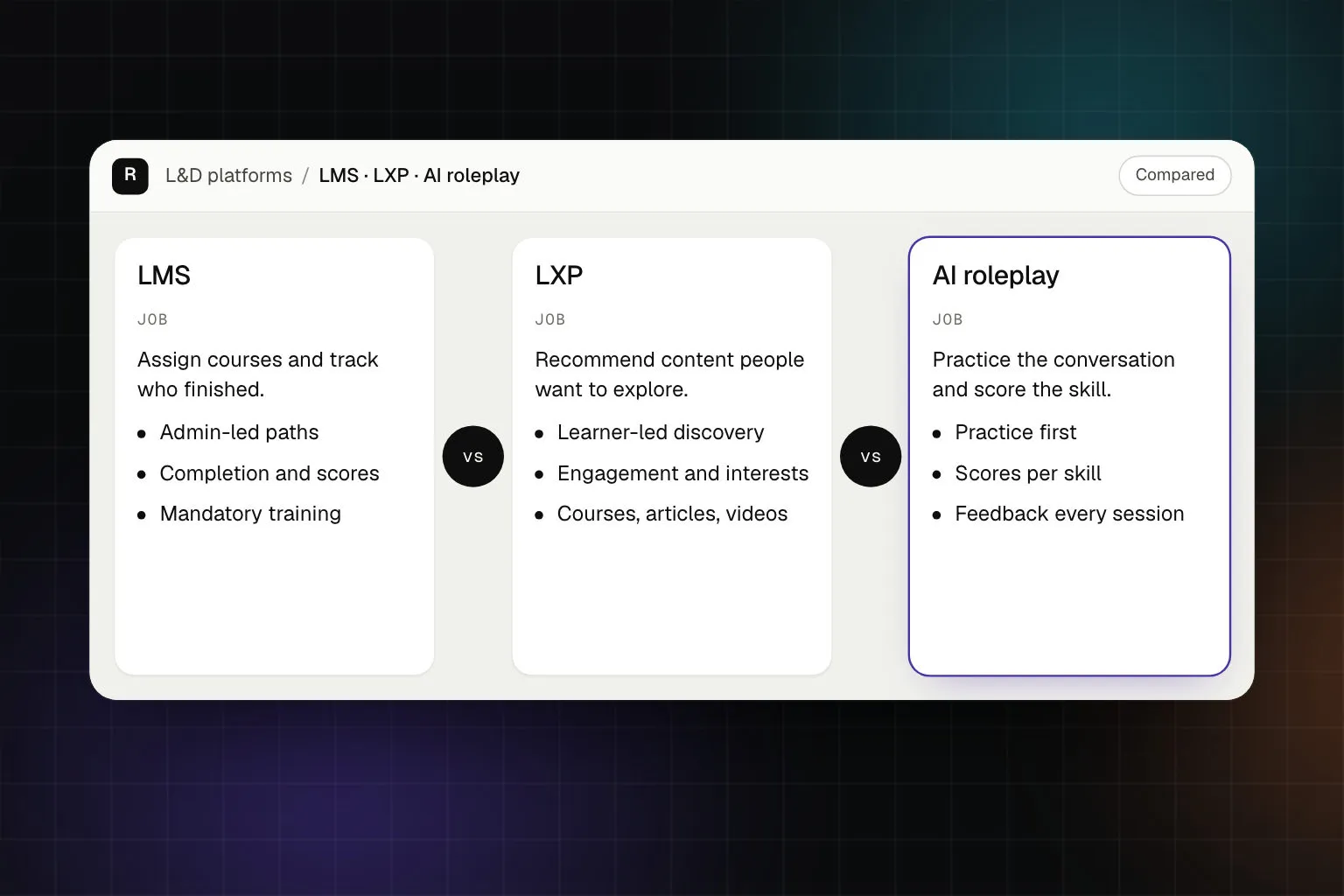
- An LMS assigns and tracks courses: who has to take what, by when, and who finished.
- An LXP recommends content by role and interest, so people find what to learn on their own.
- AI roleplay lets people practice a work conversation and shows the skill with a score.
- What separates them is the sequence, not the feature list.
LXP vs LMS: what is the difference?
A learning management system (LMS) is built for the administrator. L&D assigns courses to people, groups or roles, sets deadlines and tracks completion and scores. It hosts course packages, usually in SCORM format, and keeps the records mandatory training depends on. An LMS answers one question well: did the right people complete the right training?
A learning experience platform (LXP) is built for the learner. Instead of a fixed assignment, it recommends content by role, past activity and stated interests, and it mixes formats: courses, articles, videos, content colleagues share. Josh Bersin, who says he coined the phrase “Learning Experience Platforms,” describes the LXP as “a category of systems designed with a new philosophy: learning in the flow of work.”1 Recommendations alone don’t create time to learn, which is why employees skip the courses they are assigned.
| LMS | LXP | |
|---|---|---|
| Who drives it | L&D and admins assign | Learners choose, the platform recommends |
| Content | Structured courses, often SCORM packages | Courses plus articles, videos and shared content |
| What it records | Enrollment, completion, scores, deadlines | Activity, interests, what people viewed |
| Use it for | Mandatory training and onboarding paths | Continuous, self-directed learning |
The two are closer than the debate suggests. An LXP is a continuation of the LMS: the same core job, organizing and delivering content, with smarter recommendations on top. The sequence stays the same. Content comes first, maybe a quiz follows, and practice, if it happens at all, comes last.
Is your platform an LMS or an LXP?
Vendor labels blur, and many platforms now sell themselves as both. Look at how you use yours, not at what the contract says:
- Who starts the learning. An assignment from L&D or a manager means LMS mode. Browsing or following a recommendation means LXP mode.
- The home screen. Required courses and due dates point to an LMS. A personalized feed points to an LXP.
- The reports. Completion and overdue training are LMS reporting. Views and popular topics are LXP reporting.
- Recommendations. If content reaches people only through assignments, no LXP layer is in use.
- Learner content. Links and playlists shared by learners are an LXP trait.
Most organizations end up with a mix: required paths in LMS mode, a library in LXP mode. Both modes miss the same thing.
LMS alternatives: three categories, not one
Search for LMS alternatives and you get lists of other LMS products. When L&D teams say they need an alternative, they often mean something else. Courses are delivered, completion is high, and people still struggle in the conversations those courses were about. A rep who passed the objection handling module still caves on price.
That is not a content problem, so another content platform will not fix it. It takes a third category: AI roleplay, where people practice the conversation itself and get scored on how they handled it.
| LMS | LXP | AI roleplay | |
|---|---|---|---|
| Learning sequence | Content → test | Recommended content → optional practice | Practice → scored feedback → development plan → next practice |
| Scope | The course catalog L&D assigns | A broad library of internal and external content | Work conversations: sales, leadership, customer service, assessment |
| Built for | Training admins | Learners and talent teams | L&D teams building conversation skills |
| What it records | Enrollment, completion, test scores | Views, activity, interests | Every conversation, scored per criterion and per skill |
| Evidence of skill | A passed quiz: the person knew the answer | Engagement: the person showed interest | A scored conversation: the person did it |
Look at the sequence row. LMS and LXP differ in who picks the content, but both start with content. AI roleplay starts with practice and brings in feedback once the person has met the problem. Scores per skill from real conversations also let you find skill gaps from scored practice conversations instead of relying on self-ratings or completion rates.
What AI roleplay adds that neither one does
In AI roleplay, an employee holds a real work conversation with an AI character, by voice, with a video avatar or in chat. A rep runs a discovery call with Emily · AI prospect. A manager explains to Finn · AI employee why he was passed over for the lead role. A service agent handles Sofia · AI customer, whose order has arrived damaged for the second time. The character pushes back the way the real person would, and it knows your policies, products and procedures from your own materials.
Then comes the part an LMS or an LXP cannot do: the conversation is scored. On The Reflection:
- Your competency model. Each session is scored against your own criteria, skill by skill.
- Feedback after every session. The AI coach explains what worked and what to change, criterion by criterion.
- Video review. People rewatch their session with comments pinned to the exact second. Second-by-second review gets people to their target skill level 40% faster than summary-only feedback.
- A development plan. Every session adds to each person’s individual development plan, with analytics by person, team and cohort.
- An expert check. Your experts can score the same sessions. AI and expert scores correlate at r = 0.80, re-measured quarterly.
Skills like empathy are scored from what people say: whether they name the other person’s concern and respond to it, not from their voice or face. Your L&D team builds scenarios and characters itself, with no developers, in 50+ languages. Repeated, scored practice is also the missing piece in why knowledge from a course rarely reaches the job.
A pharma company used this to get more than 500 medical reps ready for a drug launch. Instead of weeks of live roleplays with trainers, the reps were field-ready in three days, and trained territories saw +28% sales. Here is how 500+ medical reps got field-ready in three days, and the full picture of an AI roleplay platform for sales, leadership and service conversations.
What to check in an AI roleplay platform
AI roleplay is one use of AI in training; for the wider map, see where AI helps L&D beyond roleplay. Roleplay tools differ more than the label suggests. Before you compare prices, ask seven questions:
- How many areas does it cover? Many tools cover one area, usually sales. Needing leadership or service too then means several tools, each with its own content, scoring and admin.
- Who builds the scenarios? If every new scenario goes through the vendor, practice moves at the vendor’s pace.
- Does it score on your model? Generic criteria give generic feedback.
- Can you check the scores? Ask how AI scores compare with expert assessors, and whether your own experts can score the same sessions.
- Does the character know your material? Only then does practice test what your people actually need to say.
- Does it work with your LMS? SCORM and xAPI decide whether practice fits your existing paths or becomes yet another tool.
- Where is the data hosted? Ask for the region and a data processing agreement.
The Reflection answers all seven in one platform: sales, leadership, frontline and customer service, and assessment; scenarios your team builds; scores your experts can check; LMS integration through SCORM and xAPI on the Enterprise plan; hosting in the EU (Microsoft Azure, France Central) or the US, and the customer chooses. For specific vendors side by side, see AI roleplay platforms compared fact by fact, with sources.
Are you migrating, or working alongside your LMS?
Once you know which category solves your problem, the real decision is rarely about features. It is about what you already run.
- No LMS yet. If your priority is conversation skills, there is little reason to start with a content-first system. Start with practice, and add an LMS when mandatory training calls for one.
- Replacing your LMS. Keep two decisions apart: which system delivers and tracks courses, and how people practice. A new LMS is still a content system. Switching to it will not change how your reps handle a price objection.
- A large, embedded LMS. Years of course libraries, integrations and workflows make ripping it out expensive and slow, so practice usually runs alongside it.
Is AI roleplay an LMS replacement?
For delivering courses and mandatory training, no: the LMS stays your system of record for who completed what. For the part of learning where people have to practice a conversation, yes. AI roleplay takes it over: practice, scoring, feedback and progress by skill. The results still flow back to the LMS.
How AI roleplay runs inside your LMS
On The Reflection, practice lives inside the LMS you already run:
- We build the package. Your scenarios and criteria go into a SCORM package built for your organization. There is no catalog of ready-made modules.
- You add it like any course. Upload it to any LMS that supports SCORM 1.2 or 2004, and assign it to a group, a role or an onboarding path.
- People practice. They launch the scenario from the LMS and talk to the AI character on a laptop or a phone.
- Results come back. Completion and score return to the LMS. With xAPI, every conversation is also sent to your learning record store (LRS) with its result.
LMS integration is part of the Enterprise plan. Here is how to run AI roleplay inside your LMS through SCORM and xAPI, with everything that connects today.
The request we hear most from L&D teams goes like this: we have a big LMS full of courses, and we want people to practice without moving anything. What works is to treat practice as one more course. The scenario arrives in the LMS as a package, gets assigned to the role or onboarding path people are already on, and the score comes back next to their other results. We start with the one conversation that hurts that role most, often a price objection or a first difficult one-on-one. Practice slots into a path that already exists, and L&D finally sees readiness, not just completion.
Questions L&D teams ask about LMS and LXP
What is the difference between SCORM and an LMS?
SCORM is a standard for packaging a course and exchanging results with the system that runs it. The LMS is that system: it launches the SCORM package, tracks progress and stores completion and score.
What is replacing SCORM?
The main successor is xAPI (Experience API), now an IEEE standard: IEEE 9274.1.1-2023, published in October 2023.2 xAPI sends learning records as statements to a learning record store, so it can track activity outside a course player, such as a practice conversation. Often the two run side by side: SCORM for the course in the LMS, xAPI for detailed records.
Is SCORM outdated?
No. It is old, but it is the most widely supported format in corporate LMS, and it returns completion and a score with no extra setup. xAPI is worth adding when you want detailed records outside the LMS.
Can an LMS and an LXP work together?
Yes, and many companies run both: the LMS for assigned and mandatory training, the LXP for content people explore on their own. Practice adds to either as one more course in your LMS: see how AI roleplay runs inside your LMS.
Sources
- Josh Bersin. The Learning Experience Platform (LXP) Market Expands. September 27, 2018.
- IEEE Standards Association. IEEE 9274.1.1-2023: IEEE Standard for Learning Technology — JavaScript Object Notation (JSON) Data Model Format and Representational State Transfer (RESTful) Web Service for Learner Experience Data Tracking and Access. Published October 6, 2023.