
On this page
- Most AI in L&D speeds up the L&D team: drafting, translating and recommending content.
- What changes behavior is practice with feedback, and feedback is what most employees rarely get.
- AI makes feedback possible after every practice conversation: a score on each of your criteria and comments pinned to the exact second of the recording.
- Start with one conversation that costs money when it goes wrong, four to six criteria and your own experts checking the AI.
AI in learning and development: content is the easy part
Talk about AI in learning and development usually starts with efficiency: how much time it saves, how many courses it produces. L&D teams are asking: 71% of L&D professionals are exploring, experimenting with or integrating AI into their own work1.
But faster content is not the real opportunity. Most companies already have more content than their people finish. The bigger change is something that used to be impossible at scale: feedback on how each employee handles the conversations of their job, after every practice run, not once a year in a review.
How can AI be used in learning and development?
Most uses of AI in L&D fall into five groups. For each, ask two questions: what does it save the L&D team, and does the employee get feedback on their own work?
| Use | What it saves L&D | Feedback on the employee’s own work? |
|---|---|---|
| Drafting courses and quizzes | Hours of writing per module | No. More material, not a view of how they perform. |
| Translation and localization | Agency work for each new language | No. The same course reaches more people. |
| Recommendations and learning paths | Assigning content by hand | Indirectly. The path follows quiz results and clicks, not behavior at work. |
| Skills and gap analytics | Spreadsheets and surveys | Partly. The team sees the gaps; the employee rarely sees why. |
| Practice conversations with an AI character | A trainer or expert for every roleplay | Yes. Every run is scored, with what to repeat and what to fix. |
The first four make L&D faster. Only the last has people practice the skill itself and hear back on it, so it is the one that changes behavior. For where it sits next to your LMS, see how an LMS, an LXP and AI practice split the work.
Why feedback is the missing ingredient
In most companies, feedback is the scarcest part of learning. It goes missing in three places.
- Between manager and employee. Managers are the right people to say how a call went and the least likely to have time to listen to one. Feedback waits for the next review.
- Between trainer and participant. In a workshop, a trainer watches a few roleplays. Everyone else practices unobserved, and after the session nobody watches at all.
- Between peers. Colleagues see each other work every day, but few say what they noticed in a way the other person can use.
Gallup found that 80% of employees who say they have received meaningful feedback in the past week are fully engaged2. That is a link, not proof of cause, but it is hard to ignore.
Feedback is not automatically good, though. Kluger and DeNisi found that feedback improved performance on average (d = 0.41), yet over a third of feedback interventions made performance worse3. Hattie and Timperley reached a similar conclusion for learning: feedback is one of its most powerful influences, positive or negative, depending on the type of feedback and how it is given4. Feedback that helps is specific and about the task, not the person.
Ask employees what would make training genuinely useful, and you rarely hear “more content.” You hear “tell me how I did, and what to do differently next time.”
Take a sales manager with a full team and a calendar of back-to-back calls. Every rep would gain from a review of their last discovery call, but listening to each recording takes an hour that never appears. So feedback waits for the next review. What we do instead is hand the first pass to the AI. Reps practice one discovery call against four to six criteria and get comments after every run. The manager reads the scores, opens the runs where a criterion stays low and adds a comment at the exact second. Our takeaway: a manager’s hour goes further on judgment than on listening.
What AI feedback for employees looks like
On an AI roleplay platform, the employee has a work conversation with an AI character by voice, with a video avatar or in a text chat. For example, the character can be Emily · AI prospect, a buyer whose company is adding fifteen reps next quarter. The employee runs the discovery call. Then the feedback starts.
- A score on each criterion of your competency model, not one overall grade, so the employee knows which skill to work on next.
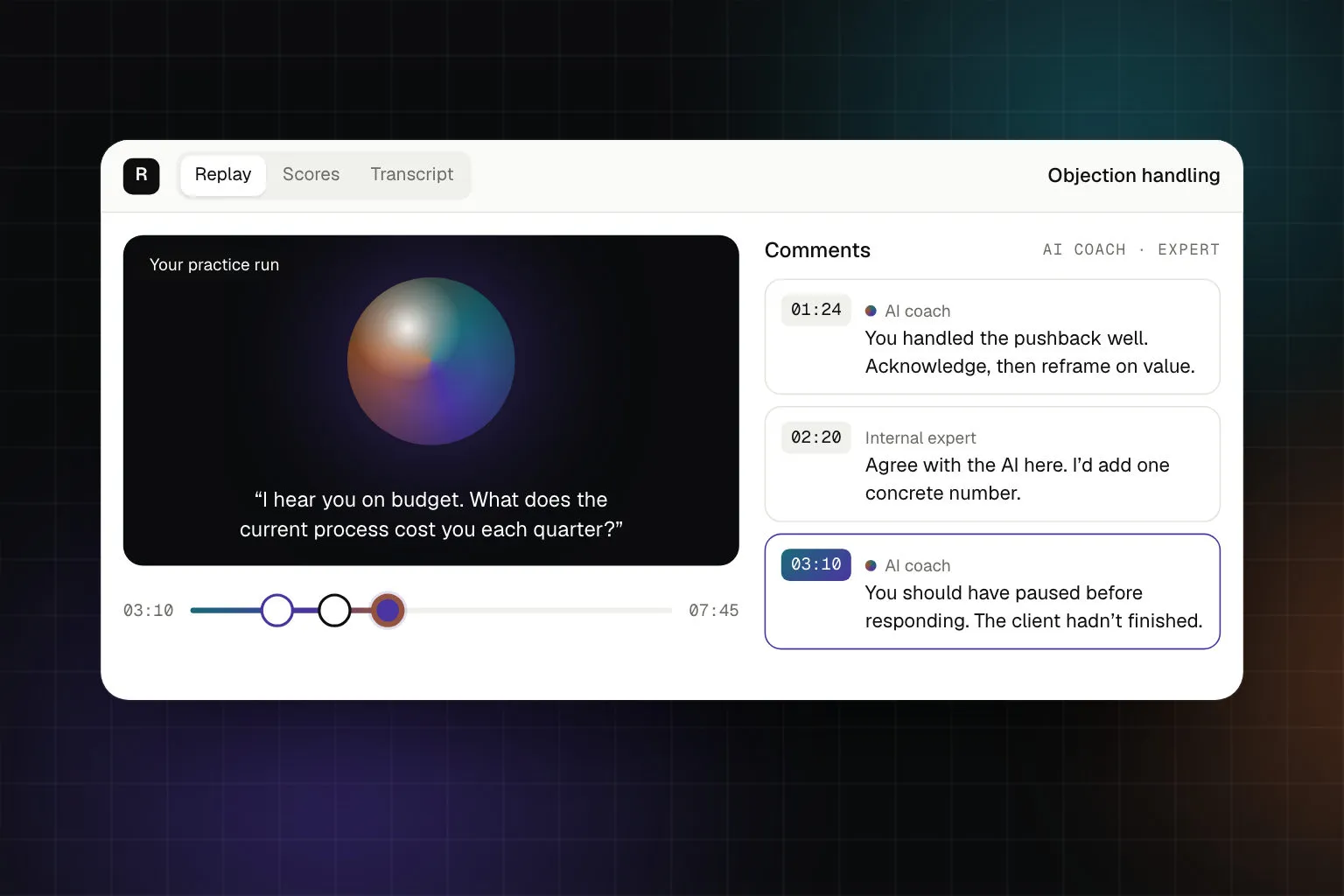
- AI coach comments right after the session, with a clear next step: “You handled the pushback well. Next: pause before you answer.”
- The recording on a timeline. People rewatch their session, and the AI coach and your internal experts pin comments to the exact second: at 1:24, you handled the pushback well; at 3:10, you should have paused before answering. Video review comes with every plan, voice sessions included.
- Peer practice. Two employees roleplay with each other, and the AI observes and scores one or both.
Instead of one score at the end, everyone sees what to repeat and what to fix. That detail is what moves people: 40% faster to target skill level with second-by-second video review than with summary-only feedback.
Soft skills are scored the same way. Empathy and active listening are judged on what the person says, such as whether they name the other side’s concern and respond to it, not on their face or voice. That is how an AI roleplay platform where employees practice and get scored on your competency model works day to day.
Can you trust feedback from AI?
We test the AI the way you would test a new assessor: the AI and expert assessors score the same sessions independently, item by item on the competency checklist, and the scores correlate at r = 0.80, a very strong correlation, re-measured every quarter. That is not “80% accuracy”: it means that where experts score a checklist item higher, the AI tends to score it higher too.
You don’t have to take our number on trust. Your own experts can score the same sessions in their own module, next to the AI. Where the two disagree, you see it. For the method, see how we check AI scores against expert assessors.
Practice built on your company, not generic soft skills
A generic “calm down an angry customer” exercise teaches generic answers. Your L&D team builds scenarios around your own business, with no developers:
- The AI character: a client, a subordinate, a colleague, even a technical system.
- Your products and competency model: the scenario speaks your product language, and scoring runs on your framework.
- A knowledge base: upload policies, product documents and regulations, and the AI character knows your company.
- Scenario series with memory: the character remembers the last conversation and picks up where it ended, for a multi-stage sale, coaching one employee or a negotiation across several meetings.
Scenarios and feedback run in 50+ languages. To get a feel for the format, browse example roleplay scenarios built around a company’s own products.
Risks to plan for
- Data. Practice sessions are recordings of your people at work. Ask where they are hosted and whether they train anyone’s model. With us, hosting is in the EU (Microsoft Azure, France Central) or the US, the customer chooses; we sign a DPA with every customer, and models are not trained on customer data. Here is where the data is hosted and how it is protected.
- Bad feedback is worse than none. Over a third of feedback interventions made performance worse3. AI that gives vague feedback multiplies the problem across every employee. Check it against your experts from the first sessions, and keep checking.
- Emotion recognition at work is banned in the EU. Since 2 February 2025, the EU AI Act has prohibited AI systems that infer the emotions of people in the workplace and in education, except for medical or safety reasons5. Feedback should be about what was said, not about a face or a voice. On our platform, only the AI character has a mood, as part of the scenario.
- Decisions about people stay with people. The AI produces scores and evidence. Your team decides who gets promoted or trained further, and can disagree with the score.
Will L&D be replaced by AI?
No. What AI removes is a bottleneck: an expert no longer has to sit in on every practice run. Repetition and first-line feedback move to the AI. The work that decides whether training pays off stays with L&D:
- Setting the standard: which conversations matter, and what good looks like, written as criteria.
- Building scenarios with the people who know the job.
- Calibrating the AI with your own experts.
- Reading readiness instead of completions: who improved, where gaps remain, what to train next.
- Handling the hard cases: disputed scores and conversations that need a human judgment call.
L&D stops being a content producer and becomes the owner of the standard, a far stronger position for budget talks.
How to start with AI in L&D: one conversation first
Start narrow: one conversation, practiced well and often.
Step 1: Pick one conversation that costs money
A discovery call, a customer complaint, feedback to an underperforming employee: one where a bad outcome has a price you can name.
Step 2: Write four to six criteria
Each describes behavior you can point to in the conversation, taken from your competency model or sales method.
Step 3: Make practice frequent and short
A first run before any teaching shows where each person starts. Then come short repeats with feedback after every run, and a harder version once the basics hold. A skill practiced once tends to slip; here is why skills from a course fade without repeat practice. Short sessions are also how practice fits into a busy working day.
Step 4: Keep your experts in the loop
Your experts score some of the same sessions as the AI. Where they disagree, sharpen the criterion.
Step 5: Measure the skill, not the completion
Track per-skill scores over time, look at gaps by skill and team, and pick the next conversation. On the Enterprise plan, you can send practice results to your LMS with SCORM and xAPI.
At scale: a pharma company prepared 500+ medical reps for a drug launch, with +28% sales in trained territories. Here is the pharma launch case, from weeks of roleplays to three days. In retail, trained stores saw a sustained +30% sales increase. To try it on your own conversation, there is a 14-day free trial through the form below.
Questions L&D teams ask about AI
What does AI do in training and development?
Most tools sold as AI for training and development do one of two jobs. They speed up L&D by drafting, translating and recommending content, or they give employees practice on real work conversations with feedback after every run. The first saves time; the second changes behavior.
Does AI feedback replace feedback from managers?
No. It takes the routine part off their plate. Managers and experts comment on the same recording as the AI, so their time goes to the moments that need their judgment.
How do you know if AI training works?
Measure the skill, not the completion rate. Compare per-skill scores before and after training on the same scenario, check the AI against your experts, then look at the business result. To put numbers on it first, calculate what a training program returns.
Sources
- LinkedIn Learning. Workplace Learning Report 2025. LinkedIn, 2025.
- Denise McLain and Bailey Nelson. How Fast Feedback Fuels Performance. Gallup, 2022, updated 2024.
- Avraham N. Kluger and Angelo DeNisi. The Effects of Feedback Interventions on Performance: A Historical Review, a Meta-Analysis, and a Preliminary Feedback Intervention Theory. Psychological Bulletin, 119(2), 254–284, 1996.
- John Hattie and Helen Timperley. The Power of Feedback. Review of Educational Research, 77(1), 81–112, 2007.
- European Parliament and Council of the European Union. Regulation (EU) 2024/1689 (Artificial Intelligence Act), Article 5(1)(f) and Article 113. Official Journal of the European Union, 2024.