
On this page
- Find out what the conflict is about first. Disagreement over the work can help a team; conflict between people and over how work gets done usually hurts it.
- Talk to each person alone before you put them in a room together, and listen for what they need, not what they demand.
- End the joint meeting with a written agreement and a date two weeks out to check it.
Every team that does real work disagrees. The question for a manager is not how to stop conflict, but which conflicts to leave alone, which to step into, and what to say when you do. This guide shows how to manage conflict in a team when it involves people you lead: how to read the situation, a six-step way through it, and an example of the conversations themselves.
What causes conflict in a team
Researchers usually sort team conflict into three kinds. Task conflict is about the work itself: which option to choose, what the data says. Process conflict is about how the work gets done: who owns what, who decides, who does the extra hours. Relationship conflict is personal: dislike, distrust, old grievances.
The difference matters. A meta-analysis of 116 studies covering 8,880 groups found stable negative links between relationship and process conflict and group outcomes, but no strong negative link between task conflict and group performance1. In other words, a sharp debate about the plan is not a problem to fix. A fight about who owns the plan, or who can’t stand whom, usually is.
The most common causes managers run into:
- Unclear roles and decision rights. Two people think they own the same thing, or neither does.
- Competing goals. One lead is measured on speed, the other on quality, and the targets pull against each other.
- Uneven workload. Someone feels they are covering for someone else, and nobody has said it out loud.
- Scarce resources. Budget, headcount, the one senior engineer everyone needs.
- Change. A reorganization, a new manager or a merged team, where old agreements quietly stop applying.
- A task disagreement that turned personal. It started as “your approach won’t work” and became “you never listen.”
Four patterns of team conflict
Before you act, count who is involved. Randall Peterson and colleagues, who have studied thousands of team conflicts, describe four patterns and estimate how often each occurs2. They also note that managers spend upwards of 20% of their time on average managing conflict, so it pays to match the response to the pattern.
| Pattern | Share of team conflicts | What to do |
|---|---|---|
| One person against the team | About 20–25% | Don’t let the team gang up on them. Talk to the person one-on-one and ask sincere questions about their view. A team-building day for everyone tends to annoy the people who know they are not the problem. |
| Two people | About 35%, the most common | If it is about the work and stays civil, it often resolves itself and can help. If it is personal, mediate in private: each person separately, then together. If that fails, change the workflow so they depend on each other less. |
| Two subgroups | About 20–25% | Don’t call a vote: the losing side rarely supports the decision. Bring in new options or a shared goal so both sides can trade on what matters most to them. |
| The whole team | Less than 15% | Usually follows poor results and turns into blame. Restate the team’s goal, and debrief as a team, looking at what everyone can do next rather than who did what. |
The rest of this guide focuses on the most common case: two people, often two leads, who have stopped working together.
How to manage conflict in a team: six steps
The order matters more than the exact words. The common shortcut is to jump straight to step 4 and put both people in a room before you know what the conflict is about.
Step 1: Decide whether to step in
Not every disagreement needs you. Step in when the conflict is personal or about process, when work is stalling, when others are being pulled into it, or when one person is being shut out. Stay out, and watch, when two people are arguing about the work and still treat each other with respect.
“I’m sure you two will sort it out.”
“I’ve noticed you and Tessa have stopped joining each other’s standups. I’d like to understand what’s going on.”
Step 2: Talk to each person separately
Meet each person alone, first. Ask what happened, what it has cost them and what they want to change. Listen more than you talk, and don’t share what the other person said. The conversation follows the same structure for a one-to-one difficult conversation: open with the purpose, stick to facts, ask for their view.
“Tessa says you’ve been dropping handoffs.”
“Walk me through the last time a handoff between your teams went wrong. What happened, from your side?”
Step 3: Separate interests from positions
A position is what someone demands. An interest is why they want it. Getting to Yes builds negotiation on four principles: separate the people from the problem, focus on interests rather than positions, invent options for mutual gain and use objective criteria3. Two leads who both demand “ownership” of something may want very different things: control of their own schedule, or not being blamed for the other team’s misses.
“So you want escalations to stay with your team.”
“If you owned escalations, what would that solve for you?”
Step 4: Run a joint meeting with ground rules
Bring them together in private, not in front of the team. Open by stating the goal and two or three rules: one person speaks at a time, talk about events rather than character, and each person sums up the other’s view before answering it. Your job is to keep the conversation on the problem, not to judge who was right.
“Let’s clear the air and figure out who dropped the ball.”
“We’re here to agree on how escalations work from next week. One rule: before you answer, say back what you heard.”
Step 5: Agree on what changes, in writing
Ask them to propose the solution. One they build together is one they are more likely to keep. Make it specific: who does what, from when, and what happens in the cases you can already predict will go wrong. Send a short written summary the same day.
“Great, so you’ll both communicate better.”
“Let me read back what we agreed, and I’ll send it to you both this afternoon.”
Step 6: Check in two weeks later
Put the follow-up in the calendar before the joint meeting ends. Meet each person briefly, then both together if needed. Ask what is working, not only what isn’t. If the agreement has broken down, go back to step 2 rather than repeating the joint meeting.
“Everything fine between you two now?”
“How many escalations went through the new process? Where did it get stuck?”
Example: two team leads who stopped talking
This is an illustrative example: the people and the company are made up. Rachel manages customer operations. After a reorganization, Joel leads support and Tessa leads onboarding for new customers. Both think escalations from new customers in their first month belong to their team. They now communicate only through tickets.
First, Rachel meets Joel alone.
- Rachel
I want to talk about how your team and Tessa’s are working together. You’ve both stopped coming to each other’s standups, and two escalations last week sat for a day. What’s going on from your side?
- Joel
Her team keeps promising new customers things support then has to deliver. And when it goes wrong, it lands on us.
- Rachel
Which case is the clearest example?
- Joel
The logistics client. Onboarding promised a custom report in a week. We found out when the client called angry.
- Rachel
So what you need is to know what was promised before the customer reaches you. Is that fair?
- Joel
Yes. I don’t care who owns it on paper. I care about not being surprised.
Rachel has the same conversation with Tessa, who says her team is blamed for every issue in the first month, even ones caused by the product. Neither of them actually needs to “own” escalations. Then the joint meeting:
- Rachel
We’re here to agree on how new-customer escalations work from Monday. One rule: before you answer each other, say back what you heard. Joel, you start.
- Joel
My team needs to know what onboarding promised a customer before they call us.
- Tessa
So you’re saying the problem is surprises, not that we promise things. My problem is being blamed for issues that aren’t ours.
- Rachel
Joel, what did you hear?
- Joel
That her team gets the blame for product bugs in the first month. That’s fair, we tag everything from new customers as onboarding.
- Rachel
What would solve both?
- Tessa
A handoff note on every new customer, listing what we promised. And support tags issues by cause, not by customer age.
- Rachel
Let’s try it for two weeks. I’ll send the summary today, and we’ll meet again on the 14th.
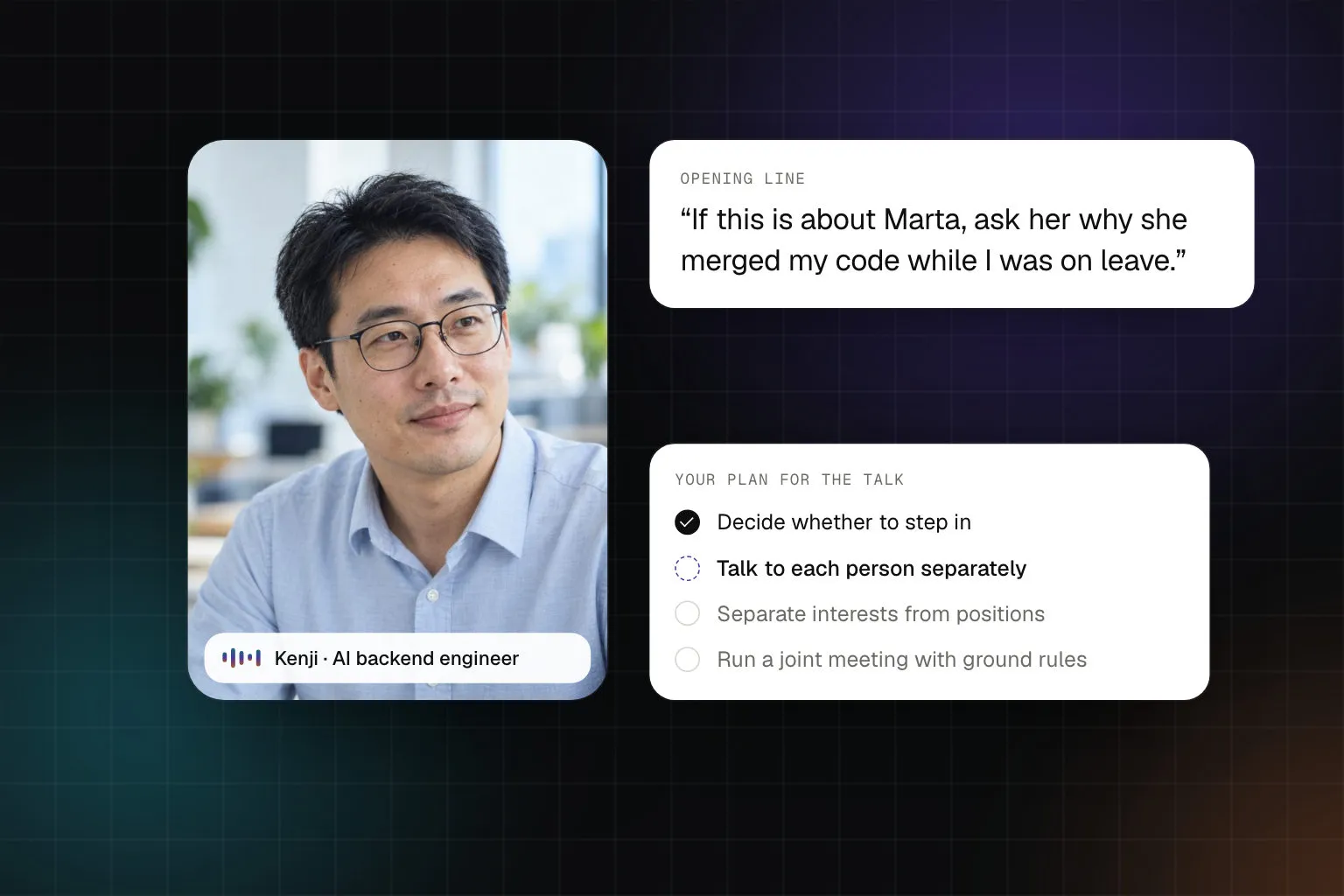
Notice what Rachel did not do. She did not decide who owns escalations, repeat what one lead said about the other, or ask them to apologize. She found what each one needed, made them listen to each other, and left with a written change and a date. To rehearse the first one-on-one, try hearing one side of a dispute between two engineers with Kenji · AI backend engineer, who expects to be blamed.
Conflict management styles
A common starting point for team conflict management is the Thomas-Kilmann Conflict Mode Instrument. It places five ways of handling conflict on two axes: assertiveness, how much you pursue your own concerns, and cooperativeness, how much you pursue the other person’s4. Its publisher’s position is that no style is best in itself; it depends on the situation. As a manager, it helps to know your default and to recognize the one each person in the conflict is using.
The “when it can fit” column below is a manager’s rule of thumb, not part of the instrument.
| Style | Assertive / cooperative | When it can fit |
|---|---|---|
| Competing | High / low | A safety or compliance issue, or a decision that can’t wait. |
| Collaborating | High / high | Both sides’ concerns matter and the relationship will last. Takes time. |
| Compromising | Medium / medium | A fair split is good enough, or a temporary fix while you work on a better one. |
| Avoiding | Low / low | The issue is minor, or people need a day to cool down before talking. |
| Accommodating | Low / high | The issue matters far more to the other person than to you. |
In the example, Joel and Tessa were both competing. Rachel moved them toward collaborating by asking for interests, not positions.
How to prevent team conflict from coming back
Most process conflicts come back if the conditions that caused them stay the same. Three habits keep them small:
- Team rules, written down. How you disagree in meetings, how fast people answer each other, what goes to the manager and what doesn’t. Agree on them with the team, not for it.
- Clear roles and decision rights. For every shared piece of work, one owner and a known way to decide. Revisit them after every reorganization, when old agreements stop applying.
- Regular one-on-ones. Tension usually shows up in a 1:1 weeks before it shows up in a meeting. Ask directly: “Is there anyone on the team you’re finding it hard to work with?”
These are skills most people learn only after they become managers. If your new leads are the ones in the middle of conflicts, look at training for new managers that includes them.
Mistakes managers make in team conflict
- Taking a side after hearing one person. The first version you hear sets your view. Hear both before you form one.
- Solving it for them. A decision you hand down settles the argument for a week. A solution they build themselves lasts longer.
- Waiting for it to blow over. Personal and process conflicts rarely do, and the rest of the team notices that you are waiting.
- Carrying messages between them. “Joel thinks you…” turns you into a participant. Bring them together instead.
- Treating a two-person conflict as a team problem. A team workshop for everyone can annoy the people who aren’t involved and doesn’t reach the two who are.
Practice the conversation before you have it
The joint meeting is hard to rehearse with a colleague: they know you, and they go easy on you. An AI character doesn’t. In The Reflection’s scenario “Two team leads who stopped talking,” the manager talks to Omar · AI shift supervisor, one side of a conflict between two leads. He pushes back the way a real lead might: “Ask him why he went to your boss instead of me.”
Managers practice conflict conversations with an AI character by voice or video. Every run ends with a score per skill and timestamped comments. What is scored is what the manager says and how the conversation is run, so skills like empathy are judged by the content of each reply. Emotions are modeled only for the AI character, as part of the scenario.
Read how one IT company cut new-manager turnover: after engineers promoted into management rehearsed their hardest conversations with an AI employee, voluntary turnover fell by 40%.
The joint meetings that went badly had one thing in common: we called them too early. We had heard one side, felt we understood the problem and put both leads in a room. Within minutes each was defending the version of events they had already told us, and we had become the judge. The meetings that worked started with a separate conversation with each person, and a first sentence about the goal, not the past: “We’re here to agree on how this works from Monday.” Now we also rehearse the opening and the hardest pushback before we walk in. A short rehearsal costs far less than repairing a meeting that went wrong.
Questions managers ask about team conflict
What is conflict resolution?
Conflict resolution is the process of getting people who disagree to an outcome they can both work with. In a team, it usually means understanding what each person needs, agreeing on a concrete change and checking that it holds.
What are three effective ways to resolve conflicts?
Talk to each person separately before bringing them together. Focus on what each person needs rather than what they demand. End with a written agreement and a follow-up date.
Can you provide some examples of conflict management practices?
A one-on-one with each side before a joint meeting; ground rules such as “say back what you heard before you answer”; a short written summary after the meeting; clear owners for shared work; and regular one-on-ones that ask about working relationships.
How do you handle conflict with a coworker?
Talk to them directly and in private before going to your manager. Describe one specific situation and its impact, ask for their view, and propose a change. The same steps apply as in how to open a difficult conversation with someone you manage.
Sources
- Frank R. C. de Wit, Lindred L. Greer and Karen A. Jehn. The paradox of intragroup conflict: A meta-analysis. Journal of Applied Psychology, 97(2), 360–390, 2012.
- Randall S. Peterson, Priti Pradhan Shah, Amanda J. Ferguson and Stephen L. Jones. 4 Common Types of Team Conflict — and How to Resolve Them. Harvard Business Review, May 7, 2024.
- Roger Fisher and William Ury. Getting to Yes: Negotiating Agreement Without Giving In. Houghton Mifflin, 1981.
- Kenneth W. Thomas and Ralph H. Kilmann. Thomas-Kilmann Conflict Mode Instrument (TKI). The Myers-Briggs Company.