
On this page
- Say why you are meeting in the first minute. Waiting makes it harder for both of you.
- Describe what you saw and its impact, not what you think of the person.
- Ask for their view before you suggest a fix, then agree on one change and a date to check it.
- Rehearse your opening out loud. It is the hardest part of the conversation.
What makes a conversation difficult
A conversation becomes difficult when the stakes are high, opinions differ and emotions run strong. That is how the authors of Crucial Conversations describe it1, and it fits what managers tell us. In practice it usually means one of four situations: performance that has slipped, behavior that affects the team, news the employee does not want to hear, or a request you have to turn down.
What they have in common is that putting them off feels easier than having them. It rarely is. The problem stays, the employee senses that something is wrong, and when the conversation finally happens it carries weeks of unspoken frustration.
Before the conversation: prepare in 15 minutes
You do not need a script. You need four things written down.
- The one thing you want to change. Not a list of grievances. If there are three issues, pick the one that matters most.
- Two or three specific examples. Dates, meetings, numbers. “On Tuesday’s client call you…” works better than “you always…”
- The impact. On the team, the customer or the results. This is what turns a complaint into a conversation about work.
- What a good outcome looks like. A behavior you will be able to see in two weeks.
Then choose the setting: a private room, or a video call with cameras on, at a time that is not five minutes before their next meeting. Leave room after it, so neither of you has to walk straight into a team meeting.
A seven-step structure for a difficult conversation with an employee
These steps work for most difficult conversations with an employee, from missed deadlines to a complaint from a colleague. Adapt the words and keep the order.
Step 1: Open with the purpose
Say why you are meeting in the first minute. Small talk followed by a sudden turn makes people feel ambushed.
“How’s everything going? … Oh, and there’s something else I wanted to mention.”
“I want to talk about the last two client reports. I’m concerned about them, and I want us to fix it together.”
Step 2: Describe what you observed
Stick to facts the employee could have seen too. Leave out labels like “careless,” “negative” or “not a team player”: they start an argument about character instead of a conversation about work.
Step 3: Explain the impact
Connect the behavior to something the employee cares about: the team, the client, their own goals. “The client asked for a call with me after the second report” says more than “this isn’t acceptable.”
Step 4: Ask for their view, then listen
Ask an open question and wait: “What’s your take on it?” The pause will feel long. Let it. You will often learn about a workload problem, a misunderstanding or something personal that changes what the right fix is.
Step 5: Agree on what changes
Ask them to propose the change first. A plan the employee suggests is one they are more likely to follow. Make it specific: what, by when, and what support they need from you.
Step 6: Set a date to review
Put a follow-up in the calendar before the meeting ends, one to two weeks out. Without it, the conversation becomes a one-off that both of you would rather forget.
Step 7: Close with the relationship
End by saying what you value in their work, if you mean it. The goal is that they leave knowing the problem is specific and fixable, not that you have given up on them.
An example: the missed deadlines conversation
Here is how the structure sounds in a real situation. Dana manages a team of analysts. One of them, Sam, has missed three deadlines in a month.
- Dana
I want to talk about the last three reports. Each one came in after the deadline, and I want to understand what’s happening.
- Sam
I know. It’s been a lot lately.
- Dana
The quarterly report was two days late, and the client asked me about it on Thursday’s call. What’s been getting in the way?
- Sam
Honestly, data requests from the sales team keep jumping the queue. I never say no to them.
- Dana
That helps. What would make it possible to hit the next deadline?
- Sam
If requests from sales came through you, I could plan my week.
- Dana
Let’s try that for two weeks. I’ll tell the sales leads today, and we’ll check in on the 24th.
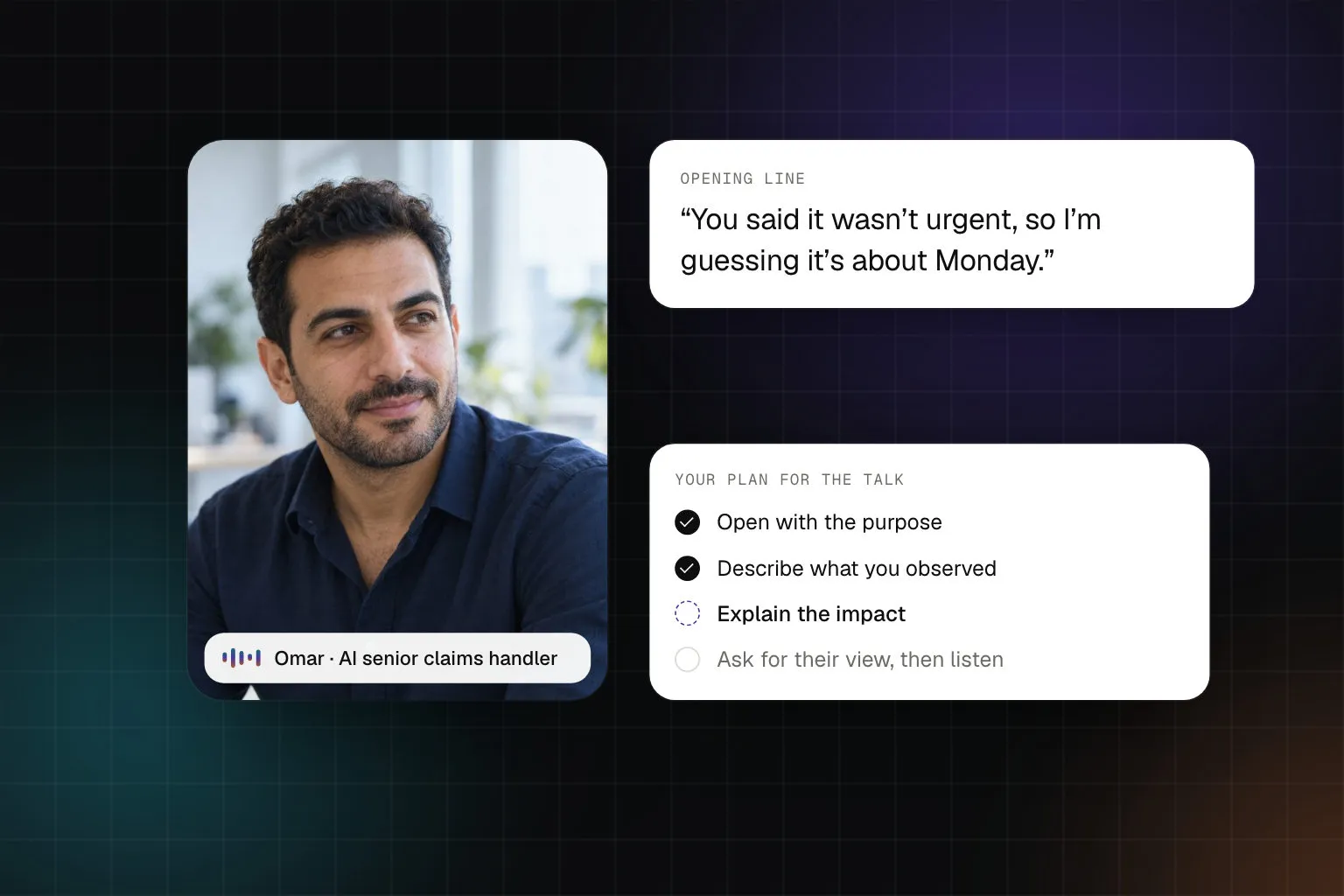
Notice what Dana did not do. She did not guess at the reason, lecture, or list every late report from the past year. She described one pattern, asked a question, and agreed on one change with a date. For the same structure with your most experienced person, rehearse corrective feedback for a senior employee braced for a reprimand with Omar · AI senior claims handler.
Five mistakes that derail a difficult conversation
- The compliment sandwich. Praise, criticism, praise. People learn to brace for the middle, and the message gets lost.
- Talking about personality. “You’re not proactive” starts a debate. “You didn’t flag the delay until the deadline” starts a plan.
- Bringing a long list. Five issues at once feel like a case being built. Pick one.
- Filling the silence. If you answer your own question, you will never hear theirs.
- Leaving without a date. No follow-up usually means no change.
When the employee reacts strongly
Strong reactions are normal, and they usually pass if you stay calm. Respond to the reaction first, then come back to the topic.
| Reaction | What it can sound like | What to do |
|---|---|---|
| Anger | “This is unfair. Nobody told me.” | Slow down, acknowledge the feeling, restate one fact: “I hear that this feels unfair. Let’s look at the dates together.” |
| Tears | Silence, or “Sorry, give me a minute.” | Offer the minute, water or a short break. Don’t rush to end the meeting or drop the topic. |
| Denial | “That’s not what happened.” | Ask what they saw. Compare examples, not interpretations. |
| Silence | Short answers, eyes on the table. | Ask a smaller question: “Which part of this is hardest to hear?” |
| Blaming others | “Sales keeps changing my priorities.” | Take it seriously and keep it separate: “Let’s fix that too. What can you change this week?” |
Practice before the real one
Most managers learn these conversations on the job, with a real person on the other side. Rehearsing first changes that. Say your opening out loud, to a colleague or to an AI character that pushes back the way your employee might, and listen to how it sounds.
In difficult conversations training on The Reflection, managers practice with an AI employee by voice or video and are scored after every attempt on the steps above: a clear opening, specific examples, listening and an agreed next step. Start from one of our roleplay scenario examples, or have one built around a situation your managers face.
The conversation managers dread most is the one they keep putting off. A team lead sees a strong performer start missing deadlines, waits a few weeks in the hope it fixes itself, then raises it after a long, apologetic warm-up. By the time the point arrives, the employee is on the defensive and the meeting turns into a debate about one late report. What works is the opposite: name the issue in the first two sentences, give two concrete examples, then ask for their side and listen. Managers who rehearse that opening out loud walk in calmer and leave with an agreed next step. Pick the conversation you’ve been postponing and practice it first.
Questions managers ask
How do you start a difficult conversation?
Name the topic and why it matters in your first sentence, without small talk: “I want to talk about how yesterday’s client meeting went, because I think we need to change how we prepare.”
Should HR be in the room?
For everyday conversations about performance or behavior, usually not: it turns a coaching conversation into a formal process. Talk to HR before the meeting if it may lead to a formal warning, involves a complaint about harassment or discrimination, or touches on health. Follow your company’s policy.
Should you put it in writing?
Send a short summary after the meeting: what you discussed, what you agreed on and the review date. It protects both of you and makes the follow-up easier.
How long should it take?
Plan 20 to 30 minutes. If it runs much longer, agree to continue in a second meeting rather than pushing for a conclusion.
Sources
- Kerry Patterson, Joseph Grenny, Ron McMillan and Al Switzler. Crucial Conversations: Tools for Talking When Stakes Are High. McGraw-Hill, 2002.
- Douglas Stone, Bruce Patton and Sheila Heen. Difficult Conversations: How to Discuss What Matters Most. Viking, 1999.