

Last updated: July 2026
"LMS alternative" gets used as if it describes one type of product. It doesn't. At least three distinct categories get grouped under that label, and they're built on different assumptions about how people actually learn. Confusing them leads to buying the wrong tool for the problem you actually have.
The short answer
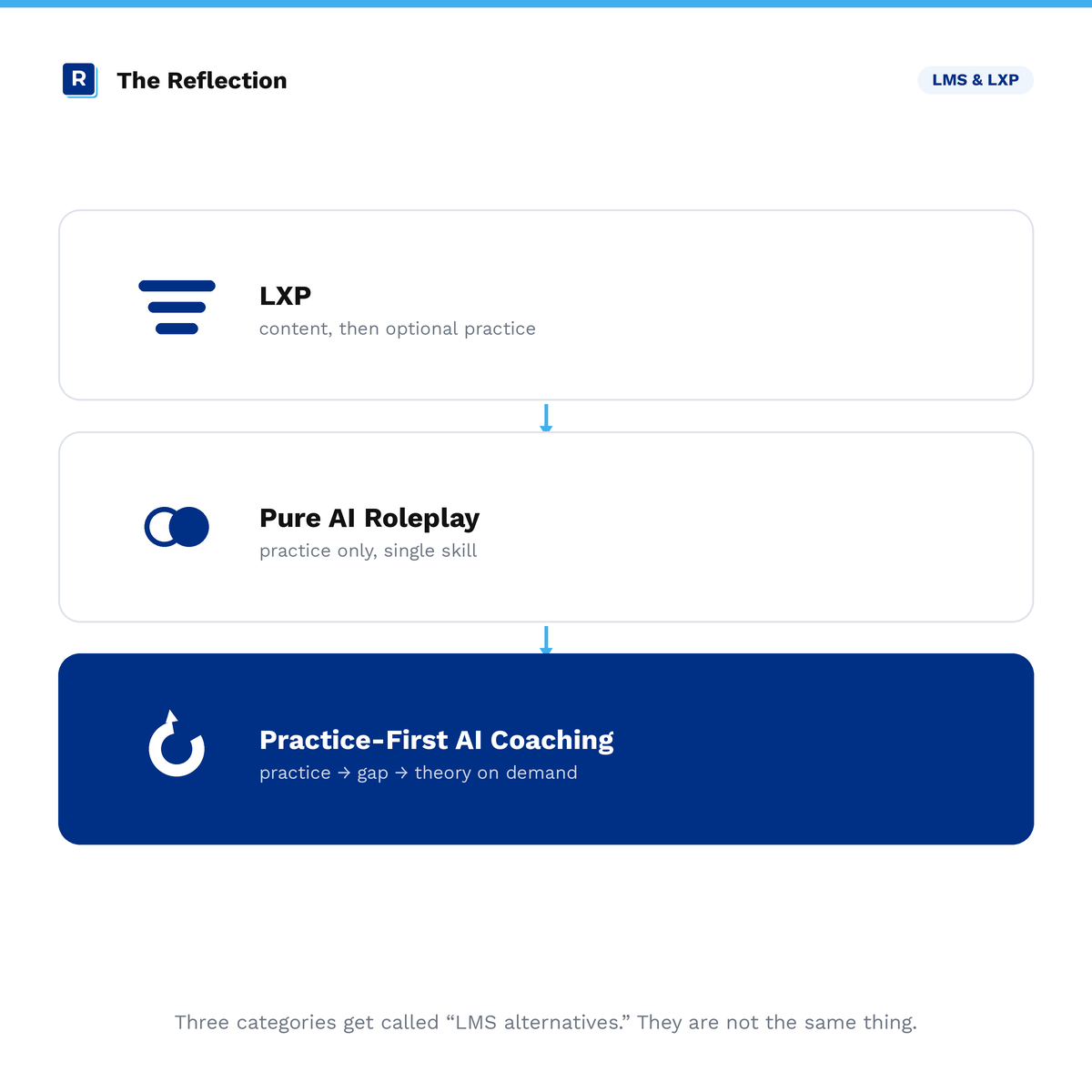
- LXPs are LMS platforms that added AI-driven content recommendations. They still push content first, just more intelligently.
- AI roleplay tools are narrow, single-skill practice tools — usually scoped to one thing, most often sales conversations.
- Practice-first AI coaching platforms flip the sequence entirely: practice comes first, theory is available on demand, and the system is built around the learner's actual skill gaps rather than a course catalog.
Here's what separates them, and why the sequence — not the feature list — is what actually matters.
1. LXPs — the LMS, evolved
A Learning Experience Platform is, structurally, a continuation of the LMS. It was built by the same industry, to solve the same core job — organizing and delivering content — with a smarter recommendation layer on top. Instead of an admin assigning a fixed course, an algorithm suggests content based on role, past activity, and stated goals.
Examples: Docebo, 360Learning, Learning Pool, Cornerstone.
The learning sequence is still: browse or get recommended content → consume it → optionally get tested on it. Practice, if it happens at all, comes after the content, not before it.
2. Pure AI roleplay tools — narrow, and usually single-skill
This category exists to solve one specific problem: giving someone a place to rehearse a conversation before they have it for real. Most of these platforms are scoped to a single skill area by design.
Second Nature uses video-based AI avatars for sales pitch and objection-handling rehearsal, and is typically deployed alongside an existing LMS — it integrates with systems like Cornerstone or SuccessFactors rather than replacing them. Hyperbound takes a voice-first approach: AI buyer personas built from a company's ICP, focused on live-call realism over structured learning paths. Retorio works on a different mechanism — multimodal behavioral analysis, reading tone, facial expression, and pacing rather than just conversation content — applied to sales, service, and leadership coaching.
All three are point solutions. Strong at what they do, but scoped: a company that wants to develop sales conversation skills and leadership conversation skills and frontline service skills typically ends up buying more than one of these, each with its own content, scoring logic, and admin panel.
3. Practice-first AI coaching platforms
This is where the more interesting shift is happening. These platforms started as AI roleplay tools, then grew a knowledge and coaching layer on top — not the other way around. That order matters.
The Reflection is an example. The core loop is: the learner practices a real scenario first — a sales call, a leadership conversation, a customer interaction. The AI identifies where the specific gap is. Development from that point on focuses narrowly on that gap, at the learner's own pace, instead of a generic curriculum assigned up front. If theory is needed along the way, it's available on demand — through a searchable knowledge base built on the company's own documents, or by asking an AI coach that answers against that same material — instead of being pushed to the learner before they've encountered the problem it's meant to solve.
The other distinction from category 2 is scope: this class of platform is built by and for L&D practitioners to run development across multiple skill areas — sales, leadership, frontline service — inside one system, rather than being a single-skill specialist tool with a name that only makes sense in a sales-enablement stack.
This is a different bet than an LXP's, too. An LXP personalizes which content you see first. A practice-first platform removes the "content first" step and only pulls in theory once practice has shown it's actually needed.

Comparison at a glance
Does the new category still handle compliance?
Yes, and this is worth being direct about, because it's often assumed otherwise. Regulated industries — pharma is the clearest example — need proof that an employee completed specific training before they're allowed to speak with physicians about a product, and that record has to hold up to a regulator. Practice-first platforms track this the same way an LMS does: completion records, timestamps, pass/fail thresholds, audit-ready reporting. Compliance tracking isn't a feature unique to the LMS/LXP category anymore — it's table stakes that most modern platforms, including practice-first ones, already have.
So compliance isn't the deciding factor it used to be. The real question is different.
The actual decision: not "which features," but "are you migrating"
For a genuinely first-time buyer — a company with no LMS at all — there's not much reason to start with a content-first system today. Starting with a practice-first platform, if the priority is skill execution rather than pure content delivery, means never having to make this switch later.
For a company that's already decided its current LMS or LXP isn't working and is willing to fully replace it, the same logic applies: go look at practice-first platforms built for L&D, not narrow single-skill roleplay tools scoped to one department's problem.
For a company with a large, deeply embedded LMS or LXP — years of course libraries, integrations, workflows, org-wide rollout — ripping it out is a real cost, independent of whether the new system is better. That's the practical reason "AI roleplay platform running alongside an existing LMS/LXP" setups exist, and why they're common: not because the LMS is doing something a practice-first platform can't, but because migration is expensive and slow at that scale.
The broader trend worth watching: this category — platforms where practice comes before content instead of after — has really only existed in a mature form since roughly 2023–2025. Legacy LMS/LXP vendors are technically capable of adding roleplay and practice features, but their product logic was built content-first from the ground up, which makes that shift structurally harder for them than it is for a platform that started practice-first. Whether that plays out as LMS/LXP fading over time or absorbing these features themselves is still an open question — but it's the more useful question to ask than "which category has compliance."
FAQ
- Are LXPs and practice-first AI platforms the same thing?
No. An LXP personalizes content recommendations but still delivers content first. A practice-first platform starts with a real scenario and only surfaces theory once a specific gap shows up.
- Do practice-first platforms handle compliance and training records the same way an LMS does?
Yes, in the categories where this matters — regulated industries with training audit requirements — practice-first platforms track completion, scoring, and pass/fail thresholds the same way an LMS does. This isn't exclusive to legacy LMS/LXP systems anymore.
- If I already have an LMS, should I replace it with a practice-first platform?
Depends on how embedded it is. A smaller, more recent LMS deployment is a reasonable one to fully replace. A large, years-deep LMS/LXP rollout is usually cheaper and faster to keep running underneath a practice-first roleplay layer than to rip out entirely — which is why that combination is common in practice.
- What's the difference between Second Nature and a practice-first platform like The Reflection?Second Nature is scoped specifically to sales — pitch rehearsal and objection handling through video-based AI avatars, typically deployed alongside an existing LMS. The Reflection is built across a wider range of skill areas — sales, leadership, and other functions — and covers both soft skills (communication, negotiation, coaching conversations) and hard/technical skills (product knowledge, procedural or compliance-driven scenarios), inside one system rather than a tool scoped to a single department's use case.