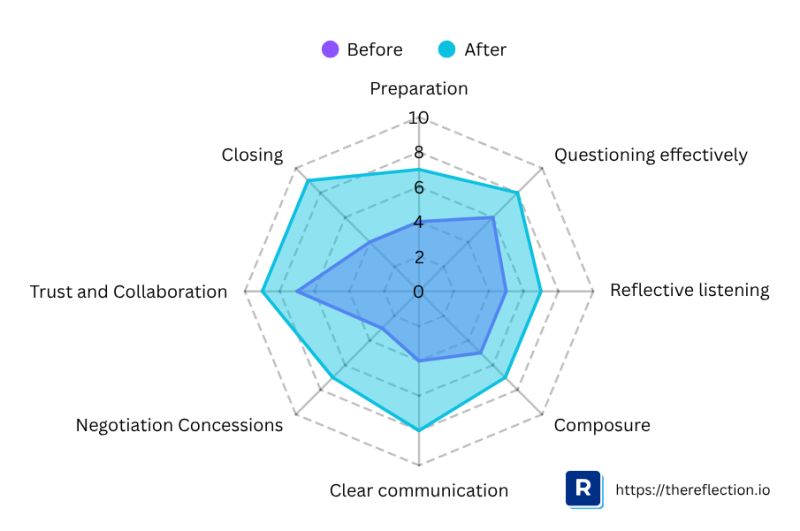


1. Executive Summary
In the pursuit of objective performance evaluation, many organizations rely on internal Subject Matter Experts (SMEs). However, our latest validation study on The Reflection platform reveals a significant disparity between human-led assessment and standardized AI scoring. This report outlines why AI is becoming the essential "Universal Benchmark" for data-driven organizational development.
2. Methodology
We analyzed a sample of 40 employees engaged in complex role-play scenarios. Performance was measured simultaneously by:
- Two independent internal SMEs using a standardized competency rubric.
- The Reflection AI scoring algorithm.
All evaluations were benchmarked on a 10-point interval scale.
3. The "Human Factor" Challenge: Inter-Rater Reliability
Our analysis revealed a mean absolute deviation of 48% between independent human raters. This variance highlights the inherent subjectivity in manual assessment. Regardless of how detailed a rubric is, human perception is influenced by cognitive noise, fatigue, and individual bias, making large-scale data comparison problematic.

4. AI Validation Results
- Criterion Validity (r = 0.72): The Pearson correlation between our AI and SME benchmarks confirms that the algorithm accurately internalizes expert-level logic.
- Leniency Bias (-0.80): Humans consistently scored ~0.8 points higher than the AI. While human feedback often leans towards supportiveness (leniency bias), the AI maintains a consistent, rigorous baseline.
- Reproducibility (11% Variance): When re-evaluating scenarios, the AI demonstrated high stability, making it a reliable tool for long-term competency tracking.
5. Driving Data-Driven Business Decisions
The value of AI in L&D lies in comparability. When human evaluations are replaced or augmented by an AI-standard:
- Organizational Benchmarking: You can now compare skill development across global departments with a single "meter."
- ROI Measurement: Organizations can objectively track how quickly skills develop following specific training interventions.
- Strategic Agility: Decision-makers can identify skill gaps based on quantifiable performance data rather than anecdotal evidence.