
Why this matters now
The gap between a good manager and a bad one shows up directly in performance, retention, and revenue.
How it works
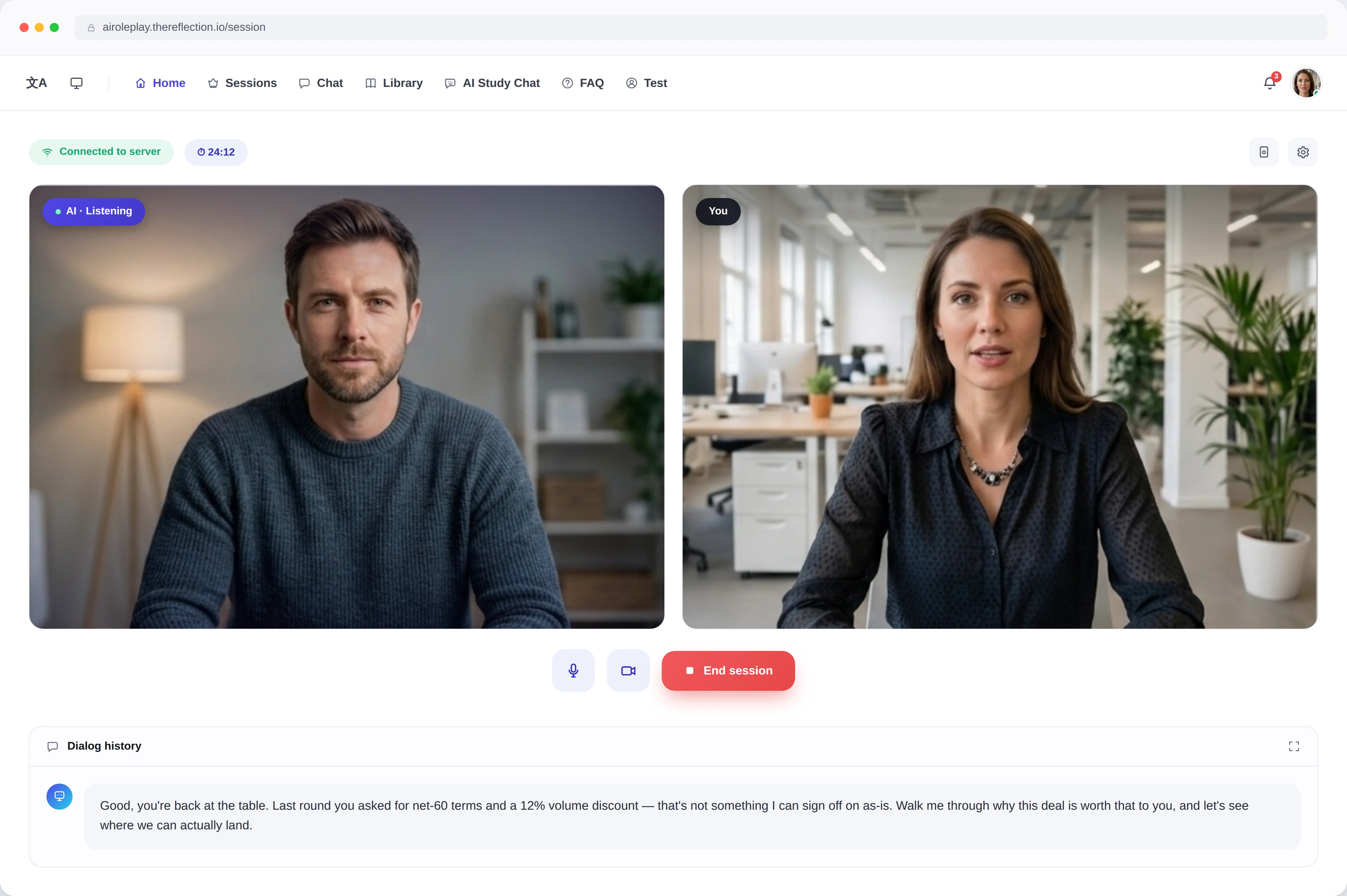
Managers can train solo against an AI persona, or roleplay directly against a colleague while the AI observes and scores the conversation.
The AI plays the employee, peer, or candidate — reacting with pushback, excuses, or emotion, the way a real person would. Available any time, no scheduling.
Two managers roleplay against each other directly. The AI observes and scores one or both sides against the same competency model, so peer practice gets structured feedback too.
What gets rehearsed
The AI plays the employee, peer, or candidate in a live conversation — built around your own team structure and cases, not a stock training scenario.
Developmental and corrective feedback, results conversations, and setting growth expectations.
Handling disagreement, excuses, passive resistance, and an employee's emotional reaction in the moment.
Setting clear goals and deadlines, agreeing on criteria, and re-opening tasks that have stalled.
Conversations about engagement, initiative, ownership, and a person's role on the team.
Aligning priorities, resources, and timelines between managers, functions, and teams.
Bring your own management cases and we turn them into interactive scenarios on the platform.
Observed in live programs
IT & Tech · Leadership
The challenge: New managers lacked the people skills to lead, which created friction and high attrition in engineering teams.
The program: High-stakes practice for performance reviews, salary conversations, and burnout conversations.
What we saw: Voluntary turnover fell by 40%, and managers reached leadership conversations faster.
Client name withheld. Figures from this program; methodology available on request.
Questions
Especially for them. The move from individual contributor to manager is one of the hardest transitions — you're suddenly accountable for someone else's work, not just your own. The platform lets a new manager rehearse the basics — setting expectations, giving feedback, handling pushback — before it happens with a real team, without risking credibility in the first few months.
The scenario list is broad and grows with each client. Common ones: developmental and corrective feedback, performance reviews, goal-setting and follow-through, motivating a burned-out or disengaged employee, termination conversations, onboarding a new hire, delegation, conflict between team members, promotion conversations (including turning someone down), retaining a key employee, deadline and discipline conversations, communicating change, and cross-functional alignment. If your company has its own recurring management cases, we turn those into scenarios too.
The AI isn't scoring for "correct" phrases — it scores the structure and outcome of the conversation: did the manager stay focused on the goal, acknowledge the employee's emotion, give feedback that was specific and verifiable, and agree on next steps. The competency model is configured per company — ready-made models exist for common management roles, but everything can be rebuilt in the scenario builder around your own criteria and how scoring actually works at your company.
Yes. The scenario builder sets the character's role and personality, department specifics, and your company's real situations — conflicting functions, distributed teams, reporting-line quirks. Scenarios are built on your own cases, not generic training examples.
That's configurable per program. It can run as a private space for practice with no results shared upward, or as an assessment tool with analytics for HR — who's strong, where the gaps are for specific managers. Both modes are supported; neither is forced by default.
Both. The characters in a conversation react emotionally — disagreement, excuses, passive resistance — and the manager has to recognize and work with that reaction, not just recite the right script. That's the part of a management conversation that's hardest to train from theory alone.
Yes, this is one of the most common use cases. A manager describes a real situation — an upcoming termination conversation, a conflict on the team, a specific employee's dropping performance — and runs it against the AI persona a few times before having the actual conversation.
One conversation usually runs 5–20 minutes — about as long as the real one would. One or two runs is enough before a specific hard conversation; for building the skill over time, short regular practice built into the workday works better than a single training day.
Same platform, different scenarios. Team leads and line managers train the fundamentals — feedback, goal-setting, handling resistance. More senior managers get scenarios around cross-functional negotiation, aligning priorities across functions, and conversations about ownership and accountability at a higher level.
It doesn't replace live coaching — it takes the load off your experts for the baseline, frequently repeated situations: standard feedback conversations, common hard conversations, regular reps. That frees up trainers' and managers' time for the cases that genuinely need a human judgment call.
Book a short demo and we'll walk through scenarios built for your own management levels.
Book a Demo